
















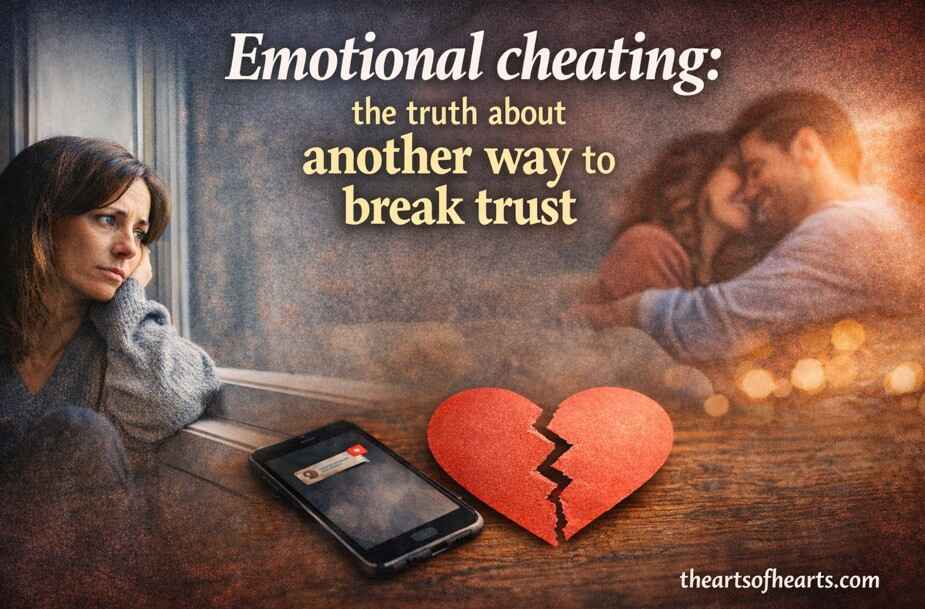
There is a reason emotional cheating creates so much confusion in relationships. Many people struggle to explain why something feels deeply wrong when there has been no sex, no clear confession, and no obvious affair in the traditional sense.
Yet the hurt is real. The distance is real. The secrecy is real. And the damage to trust can be just as serious as any physical betrayal.
Part of what makes this kind of betrayal so painful is that it often hides behind harmless language. A person may insist the connection is “just friendship,” “just talking,” or “nothing serious.”
But when emotional closeness, private intimacy, and loyalty begin shifting outside the relationship, something important has already changed. Trust is no longer safe. The bond between partners is no longer protected in the same way.
This article looks at what emotional cheating really is, how it usually starts, why it cuts so deeply, the signs that often reveal it, and what both partners can do when trust has been broken in this quieter but powerful way.
What Is Emotional Cheating?
Emotional cheating happens when a person forms a hidden or inappropriate emotional bond with someone outside the relationship in a way that begins to compete with their partner’s place.
It is not simply liking someone, having friends, or enjoying meaningful conversation. Healthy friendships can exist without threatening a relationship. The difference lies in secrecy, emotional dependence, and boundary crossing.
In most cases, emotional cheating involves sharing thoughts, feelings, vulnerabilities, or excitement with someone else in a way that should primarily belong inside the relationship.
It may include constant private messaging, flirtation, confiding deeply in another person, or turning to that person first for comfort, validation, and emotional connection. The outside bond starts to carry a charge that feels intimate, special, or hidden.
That is what makes it different from ordinary friendship. Friendship does not usually require careful concealment. Friendship does not thrive on half-truths. Friendship does not need to be minimized whenever a partner asks questions.
Once a connection must be hidden, protected, or defended because it would clearly upset the relationship, the line is already close to being crossed.
Why Emotional Cheating Feels So Betraying
Many people assume betrayal only becomes serious when it becomes physical. That idea misses the real foundation of intimacy. Relationships are not built only on sexual exclusivity. They are built on trust, emotional safety, honesty, and the feeling that the bond is being protected.
That is why emotional betrayal can cut so deeply. The pain is not only about what the outside person received. It is also about what the partner lost. They may feel replaced in the most personal way.
The jokes, attention, late-night thoughts, private struggles, and vulnerable moments that once lived inside the relationship are suddenly being shared elsewhere.
For many, this feels especially destabilizing because it is easy to dismiss from the outside. The hurt partner may hear, “You are overreacting,” or, “Nothing happened.” But a great deal did happen. Time was redirected. Intimacy was redirected. Emotional energy was redirected. Often, honesty was sacrificed in the process.
There is also a particular sting in knowing that someone did not merely make one reckless choice. Emotional affairs often develop over time. They involve repeated choices, repeated secrecy, and repeated emotional investment. That slow build can make the betrayal feel deliberate, even if the person involved tells themselves it “just happened.”
How Emotional Cheating Usually Starts
Emotional cheating rarely begins with a clear intention to betray a partner. More often, it starts in ordinary, even believable ways. A person connects with a coworker, an old friend, someone online, or a person they see regularly.
The conversation feels easy. The attention feels flattering. The understanding feels refreshing. What seemed harmless begins to feel important.
At first, the shift may be subtle. One person starts looking forward to messages more than they should. They begin sharing personal frustrations about their relationship. They feel seen by the other person in a way that gives them relief or excitement.
Soon, they are turning toward that outside connection more quickly and more emotionally than they are turning toward their partner.
This is often how an emotional affair grows. It rarely happens through one dramatic leap. Instead, it grows through a series of small permissions, with more texting, more confiding, greater emotional reliance, deeper secrecy, and steady rationalizing.
The person involved may keep insisting nothing serious is happening because they are comparing it only to physical cheating. Meanwhile, the emotional center of gravity is shifting.
Digital communication has made this pattern easier than ever. Intimacy can now build quietly through chats, voice notes, social media messages, and private conversations that never leave obvious physical evidence. A connection can deepen every day while still appearing harmless on the surface.
Signs of Emotional Cheating in a Relationship
The signs of emotional cheating are not always dramatic, but they tend to cluster around the same patterns. One of the clearest signs is secrecy. A person becomes unusually protective of their phone, deletes messages, changes passwords, or grows irritated when innocent questions are asked.
The issue is not privacy alone. The issue is that transparency begins to disappear where it used to exist.
Another sign is emotional priority. If someone starts turning to another person first with news, stress, fears, or excitement, that emotional shift matters. A partner may notice they are the last to hear important things, while someone outside the relationship seems to know more and receive more.
Defensiveness is another common clue. A person may repeatedly insist that a connection is harmless while refusing to discuss reasonable concerns. They may accuse their partner of insecurity, jealousy, or controlling behavior in order to avoid looking honestly at what has changed.
Distance at home also matters. Emotional cheating often leaves a relationship feeling thinner. One partner may seem distracted, less engaged, less affectionate, or oddly unavailable. Their emotional energy is being spent elsewhere, so the relationship begins living on leftovers.
There may also be a charged quality around one particular person. The person involved lights up when that name appears, speaks about them constantly, or becomes unusually eager to see or message them. Even without direct proof, the emotional tone starts to feel different from normal friendship.
Emotional Cheating vs Friendship: Where the Line Gets Crossed
One of the biggest mistakes people make is treating all closeness outside a relationship as suspicious, or all friendships as automatically innocent. Neither extreme is helpful.
Healthy relationships need room for friendships, individuality, and emotional support from others. The real issue is not whether someone has close connections. It is how those connections are being handled.
The line usually gets crossed when the outside bond becomes secretive, exclusive, or emotionally intimate in a way that undermines the relationship. A friendship becomes a problem when one person begins hiding parts of it, defending it more fiercely than the relationship, or treating the outside person as their primary source of validation and understanding.
Another warning sign is emotional intimacy that would feel inappropriate if openly witnessed by a partner. This may include flirtatious messages, private nicknames, sexual tension, romantic undertones, or conversations that create a “special us” atmosphere.
The relationship may not be named as romantic, but it begins carrying emotional privileges that do not belong there.
A useful question is this: would the connection still look harmless if everything about it were fully visible? If the answer is no, then the problem is not friendship. The problem is the hidden intimacy around it.
Why People Fall Into Emotional Cheating
People fall into emotional cheating for many reasons, but none of them erase responsibility. Sometimes the relationship has grown distant, lonely, or resentful. Sometimes a person feels unseen and begins responding too strongly to attention from elsewhere.
Sometimes they enjoy the novelty, ego boost, or emotional excitement of being desired, admired, or deeply understood by someone new.
Poor boundaries also play a major role. Some people do not notice the danger early enough because they only take cheating seriously once things become physical. That mindset allows emotional closeness to grow unchecked.
Others know the line is blurring, but they keep moving toward it because the connection feels good and consequences still seem abstract.
Conflict avoidance can make matters worse. Instead of addressing disappointment, boredom, unmet needs, or emotional disconnection at home, a person escapes into another bond where things feel lighter and easier. The outside relationship becomes a refuge from the work their actual relationship needs.
Opportunity matters too. Regular access, digital communication, shared frustrations, and emotional vulnerability can all create conditions where attachment grows quickly. That is why emotional affairs often develop in familiar places such as work, social circles, old friendships, or online spaces where repeated private contact feels normal.
The Damage Emotional Cheating Can Do to Trust
Broken trust does not only come from bodies crossing a line. It also comes from loyalties shifting in hidden ways. Emotional cheating can leave the hurt partner questioning everything and carries signigicant consequences. They may wonder what was real, when the distance began, how much was hidden, and whether they were being quietly replaced while still expected to act normal.
This kind of betrayal often creates obsessive self-doubt. The hurt partner may replay conversations, search for clues, compare themselves to the outside person, and question their instincts.
Because emotional affairs can be harder to define than physical ones, the injured partner may also feel pressure to prove their pain. That uncertainty can intensify the damage.
The person who was betrayed may no longer trust words the same way. Reassurance sounds thinner after deception. Promises feel less comforting. Even ordinary behavior can suddenly look suspicious because the sense of safety has been shaken.
Emotional safety also suffers. A relationship cannot stay close if one partner feels they are competing with a hidden attachment. Even after the outside connection ends, the betrayal may linger because the issue was never just the other person. It was the secrecy, the displacement of intimacy, and the repeated failure to protect the relationship.
Can Emotional Cheating Be Worse Than Physical Cheating?
This question comes up often, but it has no universal answer. People experience betrayal differently, and what hurts most often depends on what the act means to them. For some, physical cheating feels more violating because it breaks sexual exclusivity in a concrete and undeniable way.
For others, emotional cheating feels worse because it suggests a deeper attachment and a more ongoing form of disloyalty.
Many people are especially wounded by the idea that their partner gave someone else the most personal parts of themselves. Sex may feel devastating, but emotional attachment can feel like replacement. It may suggest that the relationship was not merely disrespected for a moment, but slowly displaced from the inside.
Still, trying to rank betrayals can become distracting. The deeper issue is how trust was broken, what was hidden, and what meaning the betrayal carries for the couple involved. A person does not need to prove that emotional cheating is “worse” in order for it to be serious.
If the relationship’s boundaries were crossed and trust was damaged, the pain is already valid.
What To Do If You Realize You Are Emotionally Cheating
The first step is honesty. Not defensive honesty. Not technical honesty. Real honesty. If you are hiding contact, protecting a bond from your partner’s view, or turning to someone else in ways that undermine your relationship, it is time to stop minimizing the problem.
That means taking responsibility before things go further. You may need to reduce contact, end private communication, or create much stronger boundaries with the person involved. The right step depends on how far the connection has gone, but the principle is the same: you cannot repair trust while continuing to feed the bond that damaged it.
You also need to ask why this happened. That question is not an excuse. It is a necessary part of accountability. Were you lonely, angry, flattered, bored, avoidant, or emotionally careless? Were you escaping problems instead of facing them? Whatever the answer is, it should lead you back toward integrity, not further into rationalization.
If you want to protect your relationship, then your actions must show that clearly. Openness, consistent boundaries, and a willingness to face uncomfortable truth matter far more than saying, “It was not physical.”
What To Do If Your Partner Is Emotionally Cheating
If you suspect your partner is emotionally involved elsewhere, do not rush to deny your own instincts. At the same time, focus on patterns rather than panic. One conversation or one message may not prove much on its own. But repeated secrecy, emotional distance, defensiveness, and clear misplaced intimacy should not be ignored.
When you address it, try to stay grounded and direct. The goal is not to win a courtroom argument. The goal is to name what is happening and how it is affecting trust. Speak to the secrecy, the emotional shift, the hidden loyalty, and the way the connection is changing your relationship.
It is also important to listen carefully to the response. Genuine accountability sounds different from dismissal. A partner who is willing to repair trust will usually show concern for the damage, not just irritation at being questioned.
They will be willing to discuss boundaries, make changes, and take the issue seriously. A partner who keeps protecting the outside bond while minimizing your pain is showing you where their loyalty is still divided.
Do not allow yourself to be talked out of your own reality simply because the betrayal does not fit a dramatic stereotype. Emotional betrayal is still betrayal when trust is being broken in plain but quieter ways.
Can a Relationship Recover From Emotional Cheating?
Yes, recovery is possible, but only when both people deal with the truth of what happened. Healing does not begin with arguments about labels. It begins when the person who crossed the line fully accepts that trust was broken and stops hiding behind language such as “just friends” or “nothing happened.”
The outside connection usually cannot remain as it was. If you are aiming to rebuild trust after betrayal, the relationship must be protected in a visible way. That may mean ending contact, changing communication patterns, increasing transparency, and creating clear future boundaries.
The hurt partner also needs space to express pain without being rushed. Rebuilding trust is not only about stopping the harmful behavior. It is about restoring emotional safety over time. That happens through consistency, patience, truthfulness, and a clear willingness to understand the impact of the betrayal.
Some couples do recover and become stronger because the crisis forces honesty about boundaries, needs, and neglected problems. Others realize the betrayal exposed deeper patterns they can no longer ignore. Recovery is possible, but it requires more than apology. It requires change that can be seen and felt.
How To Protect Your Relationship From Emotional Cheating
One of the best ways to prevent emotional cheating is to stop assuming that both partners define betrayal in the same way. Many couples never discuss it until trust has already been damaged. Clear conversations about boundaries, private contact, flirtation, emotional dependence, and transparency can prevent a great deal of confusion later.
Protecting a relationship also means protecting emotional intimacy inside it. If distance, resentment, boredom, or loneliness are growing, those issues need attention early. Emotional affairs often gain strength in the silence created by neglected problems.
Healthy boundaries matter too. Not every strong connection outside a relationship is dangerous, but private emotional intensity should never be treated casually.
If you find yourself hiding a conversation, craving someone’s attention in a charged way, or sharing too much of your inner life with them while pulling away at home, take that seriously before it grows.
Most importantly, protect trust before you test it. Relationships stay safer when both people act with the awareness that betrayal rarely begins at the final step. It usually begins much earlier, in the small hidden choices that slowly move intimacy out of the relationship and into someone else’s hands.
The Truth About Emotional Cheating
Emotional cheating is real because trust is not only broken through sex. It is also broken through secrecy, hidden intimacy, emotional displacement, and repeated choices that stop protecting the relationship. That is why it hurts so much, even when nothing physical has happened.
At its core, this kind of betrayal is about more than messages or friendship. It is about where emotional loyalty is going, what is being hidden, and whether the relationship is still being honored from the inside. Once someone else begins receiving the closeness, priority, and honesty that belong within the relationship, trust is already under threat.
That is the truth about emotional cheating. It may be quieter than physical betrayal, but it can still shake a relationship at its foundation. And if something important is being hidden, defended, or emotionally prioritized outside the relationship, the damage has already begun.


