


















If you’ve been googling how to stop being jealous and insecure, what you really want is peace without becoming controlling.”Jealousy is one of those emotions that can make you feel both powerful and pathetic at the same time.
Powerful because it pushes you toward control, toward certainty, toward “fixing” the threat.
Pathetic because the more you chase certainty, the smaller you feel inside.
If you’re a man who keeps getting hit with jealousy or insecurity, whether you show it outwardly or swallow it quietly, this isn’t a character flaw. It’s usually a signal that something in you doesn’t feel safe.
Not “safe” like you’re in physical danger. Safe like: I can relax and still be respected. I can be chosen without having to perform. I can trust myself even if I can’t control everything.
This article isn’t going to tell you to “just be confident.” It’s going to help you understand what jealousy is actually doing, and how to stop letting it run your relationship and your mind.
What Jealousy Really Is (and Why It Feels So Urgent)
As experts point out, jealousy is rarely about the other person. It’s usually about what their behavior means in your head.

A delayed reply becomes: She’s losing interest.
A night out becomes: Someone will take her from me.
A new male friend becomes: I’m being compared, and I’m losing.
Jealousy is your nervous system trying to prevent emotional pain by predicting it early. It’s your brain saying, “If we catch the threat now, we won’t get blindsided later.”
The problem is that jealousy doesn’t just scan for real threats. It scans for anything ambiguous and fills in the gaps with your worst fear.
That’s why it’s exhausting. You’re not responding to facts, you’re responding to interpretations.
The Two Types of Jealousy That Men Often Confuse
1) Protective jealousy (boundary-based)
This is when something is genuinely disrespectful or inappropriate, and your body is reacting to a real violation.
Examples:
- Your partner hides conversations and lies about it.
- Someone repeatedly flirts with your partner, and your partner encourages it.
- Your partner crosses agreed boundaries and minimizes them.
These are instances where your standards are getting challenged, and not insecurity.
2) Wound jealousy (fear-based)
This is when your partner’s normal life triggers an old fear: rejection, replacement, embarrassment, abandonment, not being “enough.”
Examples:
- She’s friendly, and you read it as flirtation.
- She’s busy, and you assume you’re not important.
- She posts a photo, and you imagine thirsty comments as “competition.”
This is the jealousy that keeps repeating across relationships, even with different women.
Most men are dealing with wound jealousy, but they try to solve it with control, which makes everything worse.
How to Stop Being Jealous and Insecure Without Controlling Your Partner
A jealous mind always has a plan:
- Check her phone
- Question the guy
- Interrogate details
- Restrict outings
- Demand reassurance
- “test” loyalty
It can even look “calm,” like you’re just asking questions.
But control doesn’t create peace. It creates temporary relief, then a stronger rebound of anxiety. Because your brain learns: I only feel okay when I control something.
The real goal isn’t to eliminate jealousy forever. The goal is this:
You feel jealousy… and you don’t become it.
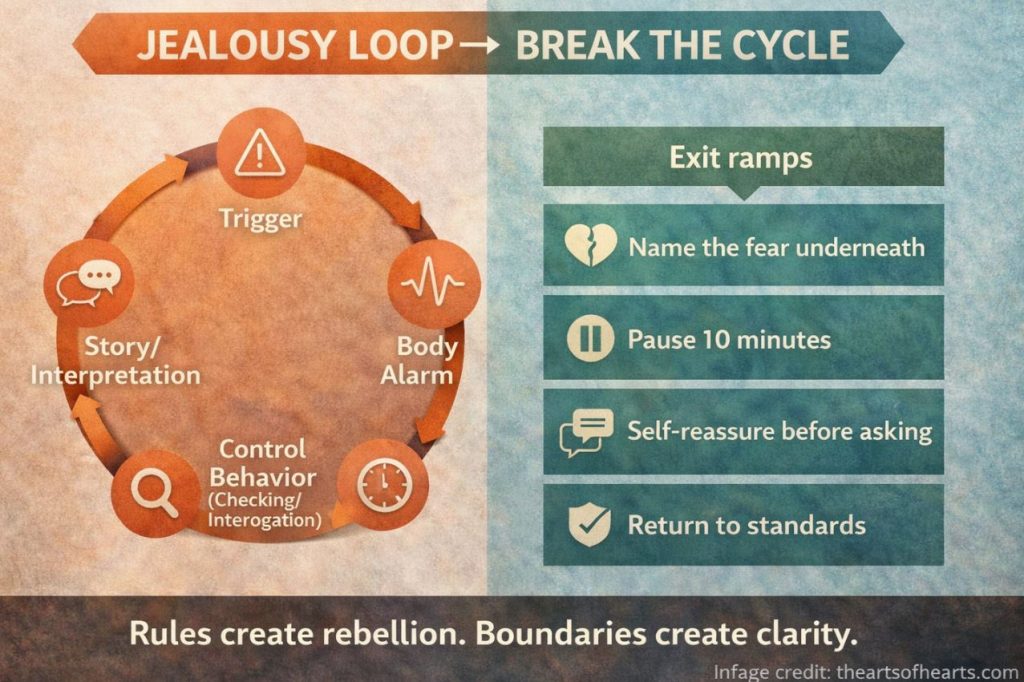
Name the fear underneath the jealous and insecure feelings
Jealousy is usually a cover emotion. Under it is something more specific and more honest.
Try this sentence and even say it out loud if you can:
“When I feel jealous, what I’m really afraid of is ______.”
Common answers:
- “I’m afraid I’m not enough.”
- “I’m afraid she’ll realize she can do better.”
- “I’m afraid I’ll look stupid.”
- “I’m afraid I’ll be abandoned.”
- “I’m afraid I’ll be replaced.”
- “I’m afraid I’ll get betrayed and not see it coming.”
This matters because you can’t heal “jealousy and insecurity” as a vague cloud. But you can work with a fear you can name.
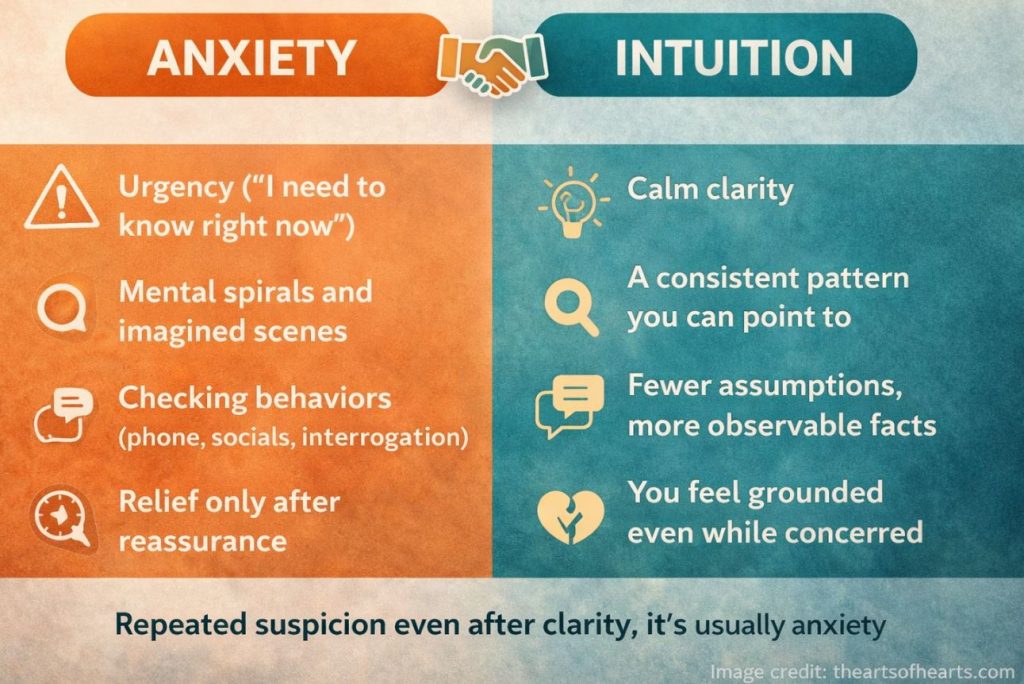
Separate “intuition” from anxiety
A big part of how to stop being jealous and insecure is learning to tell anxiety stories from real patterns. A lot of men say, “But what if I’m right?”
Fair question.
Here’s a practical distinction:
Anxiety feels like:
- Urgency (“I need to know right now”)
- Mental spirals and imagined scenes
- Checking behaviors (phone, socials, interrogation)
- Relief only after reassurance
- Repeated suspicion even after clarity
Intuition tends to feel like:
- Calm clarity
- A consistent pattern you can point to
- Fewer assumptions, more observable facts
- You feel grounded even while concerned
A simple rule:
If your “gut” needs you to investigate obsessively, then often it is just anxiety.
Stop treating reassurance like medicine
Reassurance is okay sometimes. But when you use it like a drug, you build tolerance. You need more, more often, and it stops working.
Signs you’re relying on reassurance:
- You ask the same questions in different forms
- You want details, not just answers
- You feel calm for 10 minutes, then spiral again
- You need her to “prove” something repeatedly
What helps more is self-reassurance, not affirmations, but grounding statements that bring you back to reality.
Try:
- “My fear isn’t a fact.”
- “I can tolerate uncertainty without acting.”
- “If something is wrong, it will show as a pattern.”
- “I don’t need to interrogate to be safe. I need standards.”
How to Stop Being Jealous and Insecure by Building Self-trust and Standards
This is where men often get it backwards.
They think: If I hold on tighter, I won’t lose her.
But security comes from knowing: If this becomes disrespectful, I will respond with self-respect.
That’s standards.
Examples of standards:
- “I don’t stay in relationships with secrecy and lies.”
- “I communicate directly instead of monitoring.”
- “I don’t compete for someone who wants attention from everyone.”
- “I won’t punish my partner for my fears.”
When you have standards, you don’t need constant control because you trust your response.
A lot of insecurity is really this:
You don’t trust yourself to handle pain if it happens.
Standards rebuild that trust.
How to Stop Being Jealous and Insecure Through Calm Communication
Jealousy gets most dangerous when it comes out as blame or interrogation.
Instead, aim for clean communication: honest, specific, and non-punishing.
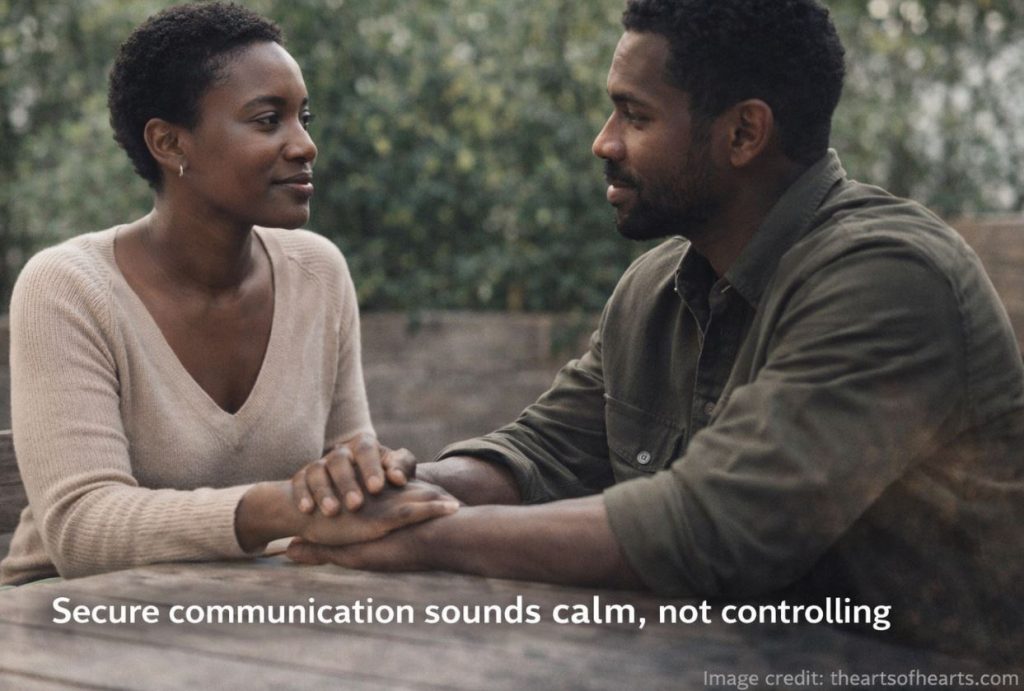
Try this script:
“I’m noticing jealousy coming up for me. I’m not accusing you of anything, but I want to name what I’m feeling before it turns into distance or control. Can we talk about what would help me feel secure and what boundaries we both want?”
That kind of honesty is masculine in the best way. It is steady, accountable, and direct.
What to avoid:
- “Why are you like this?”
- “You always…”
- “If you loved me, you wouldn’t…”
- “Let me see your phone then.”
Phone-checking is a symptom of this issue and not a relationship skill.
Identify the “story” your jealousy tells—and challenge it like a man who respects reality
Most jealousy runs on a repeating internal script.
Examples:
- Women can’t be trusted.
- If she’s attractive, she’ll cheat eventually.
- If she has options, I’m disposable.
- Love always ends in betrayal.
- I’m not the kind of man women stay loyal to.
Those stories usually come from:
- Past betrayal
- Childhood instability
- Being humiliated or compared
- Watching unhealthy relationships growing up
- Your own guilt (sometimes jealousy is projection)
Here’s the key move:
Your story isn’t “who you are.” It’s what happened to you or what you learned.
If you want a practical exercise, do this:
- Write your jealousy story in one sentence.
- Write the evidence for it (facts only).
- Write the evidence against it (facts only).
- Write a more balanced statement you can live by.
Balanced doesn’t mean you become naïve; rather, it means you have a realistic perspective.
Fix the “low self-worth loop” that keeps feeding insecurity
Jealousy is louder when your life is smaller.
Not because you need to become some alpha caricature but because when your identity depends on your partner’s validation, everything feels like a threat.
Ask yourself:
- Do I have a purpose outside this relationship?
- Do I have male friendships that keep me grounded?
- Do I respect how I’m showing up as a man—health, work, discipline, integrity?
- Am I proud of my choices?
Insecurity often eases when you start living in a way that quietly earns your own respect.
Small moves that help more than people admit:
- Lifting weights or training consistently (not for attention, just self-respect)
- Fixing sleep
- Reducing porn if it’s warping your expectations and self-image
- Building financial and personal stability
- Spending time with men who don’t feed paranoia
Your nervous system calms down when your life feels sturdy.
Learn the difference between “boundaries” and “rules”
This one saves relationships.
- Rules: “You can’t do that.”
- Boundaries: “If that happens, here’s what I will do.
Rules create rebellion or secrecy, whereas boundaries create clarity.
Examples:
Rule:
- “You can’t have male friends.”
Boundary:
- “I’m not okay with private, intimate texting with someone who clearly wants you. If that becomes a pattern, I’m going to step back from this relationship.”
The last example shows a man protecting his peace without trying to control another adult.
How to Stop Being Jealous and Insecure vs. When it’s a Real Red Flag
Sometimes men pathologize themselves when the relationship is actually unhealthy.
Consider this seriously if there’s:
- Consistent lying or gaslighting
- Repeated boundary violations
- Secretive behavior with no accountability
- Your partner enjoys making you jealous
- A pattern of “you’re crazy” whenever you raise a concern
You can work on insecurity and still require respect. In fact, that is the work.
When you should get help For Jealousy and Insecurity (and why it’s not weak)
If jealousy feels compulsive, like you can’t stop checking, imagining, interrogating, spiraling this often, then it is more than a mindset issue. It can be attachment wounds, trauma, anxiety, or depression showing up through relationships.
Therapy, especially with someone who understands male psychology and doesn’t shame you, can be a shortcut to learning:
- Emotional regulation
- Attachment repair
- Healthy boundaries
- Rebuilding self-trust after betrayal
A lot of men wait until they’ve damaged something good before they get support. You don’t need to do that.
A grounded way to measure progress
Progress isn’t “I never feel jealous.”
Progress looks like:
- You notice the trigger faster.
- You can sit with the feeling without acting.
- You communicate without accusation.
- You don’t chase certainty at the cost of self-respect.
- You choose standards over surveillance.
- You feel proud of how you handle yourself even when you’re afraid.
That’s the goal: not becoming emotionless, but becoming steady.
The Real Antidote to Being Jealous And Insecure
Jealousy shrinks when two things grow:
- Self-trust: “Whatever happens, I will handle it with dignity.”
- Self-respect: “I won’t abandon myself to keep someone.”
If you build those two, you stop begging the world to reassure you. You stop trying to control what you can’t control. And you become a man who can love deeply without fear running the show. You can also read our FAQs on this topic and learn more about jealousy in relationships.