
















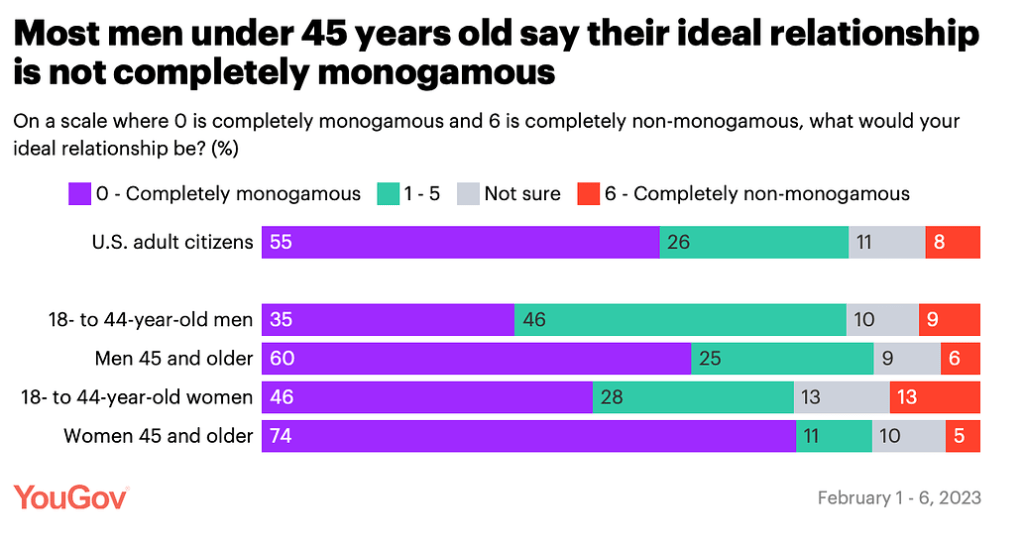
According to studies, Ethical non-monogamy (ENM) has moved from niche conversations into mainstream dating culture. Still, many people are unsure whether it is a healthy relationship structure for them, or even what it actually requires. This guide offers clear, judgment-free direction on ethical non-monogamy to help you assess your readiness, communicate with confidence, and avoid common pitfalls.
What Is Ethical Non-Monogamy?
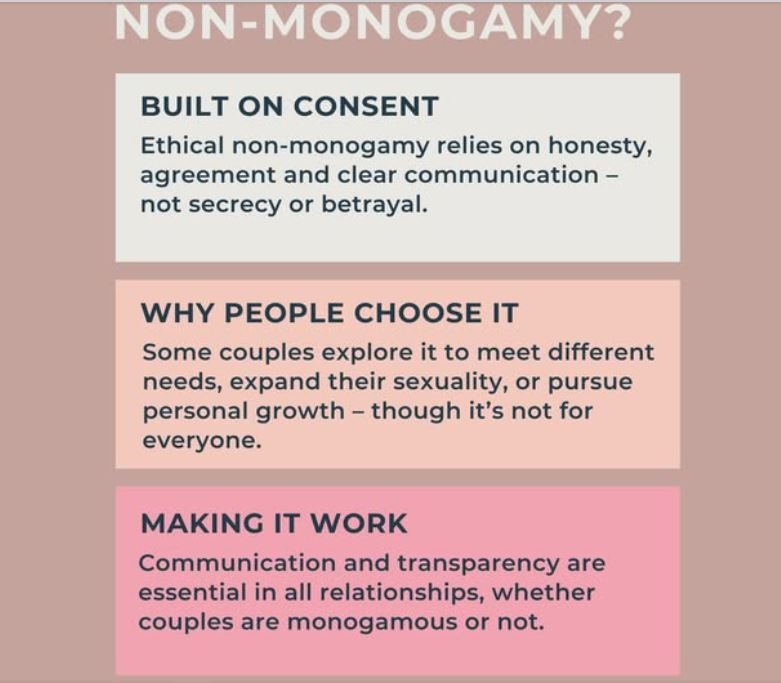
Ethical non-monogamy describes relationship structures where all partners agree that romantic or sexual exclusivity is not required. The keyword is ethical, meaning transparent, consensual, and grounded in mutual respect.

Types of Ethical Non-Monogamy to Consider
Ethical non-monogamy is not one model. It’s an umbrella term for several relationship structures, each with its own expectations, emotional demands, and communication needs. Understanding these options helps you choose what aligns with your values, personality, and emotional capacity.
1. Open Relationships
Open relationships typically involve couples who maintain a primary bond but agree that sexual or romantic interactions with others are acceptable under specific terms.
Key features include:
- Clear rules or boundaries (e.g., casual sex only, no sleepovers, limited emotional involvement).
- Transparency about outside partners or encounters.
- A shared understanding that the original partnership remains central.
This is often the easiest entry point for people exploring ENM for the first time.
2. Polyamory
Polyamory refers to engaging in more than one romantic or emotional relationship at the same time, with everyone’s knowledge and consent.
It can take several forms:
- Hierarchical polyamory: Partners acknowledge certain relationships as primary (e.g., legal spouse, shared household) and others as secondary.
- Non-hierarchical polyamory: Partners avoid ranking relationships, seeing each as unique and meaningful in its own way.
- Solo polyamory: Individuals prioritize personal autonomy—often living independently—and maintain multiple relationships without merging identities or households.
Polyamory tends to attract people who value emotional intimacy with more than one person and are comfortable balancing multiple deep connections.
3. Relationship Anarchy
Relationship anarchy (RA) deconstructs traditional expectations altogether. Instead of assuming what a relationship “should” look like, partners co-create the structure without hierarchy or predefined roles.
Core beliefs include:
- No automatic prioritizing of romantic partners over friends.
- High value placed on autonomy and individuality.
- Agreements are formed based on needs, not social norms.
RA appeals to people who dislike rigid categories and prefer organically defined connections.
4. Swinging
Swinging typically involves couples engaging in sexual activities with others—often together, but sometimes separately—with little focus on emotional relationships.
Common traits:
- Usually centered around sexual exploration rather than romance.
- Boundaries are clear and often strict.
- Frequently done within communities, events, or clubs built around shared interests.
Swinging is ideal for couples who want shared novelty without adding emotional relationships to their lives.
5. Monogamish
A term coined by Dan Savage, monogamish describes couples who are mostly monogamous but allow limited exceptions under mutually agreed conditions.
Examples include:
- Occasional flings during travel.
- Threesomes only.
- A “don’t ask, don’t tell” agreement (although many experts advise transparency over secrecy).
Monogamish arrangements work well for partners who desire monogamy as their foundation but acknowledge the value of controlled flexibility.
6. Polyfidelity
Polyfidelity is a closed relationship among three or more people who agree not to date or sleep with anyone outside the group.
Think of it as a “closed polycule.”
This option requires strong communication and compatibility, but it can offer stability for those who want multiple committed partners while maintaining exclusivity within the group.
7. Kitchen Table Polyamory
A style of polyamory where all partners—metamours included—are comfortable interacting socially, even casually.
The name comes from the idea that everyone should feel comfortable sitting around the same kitchen table.
Key elements:
- Community-like atmosphere.
- Higher emotional transparency.
- Cooperative scheduling and support.
It works best for people who appreciate interconnected relationships.
8. Parallel Polyamory
In parallel polyamory, partners are aware of each other’s other partners but do not interact socially.
This structure respects autonomy and privacy while still allowing multiple relationships.
It’s helpful when metamours differ in personality, lifestyle, or comfort level.
9. Don’t-Ask-Don’t-Tell (DADT) ENM
Some partners agree not to share details about outside relationships.
While controversial, it can work for:
- Individuals are uncomfortable with specifics but supportive of non-exclusivity.
- Long-distance or high-schedule-demand relationships.
However, DADT requires a strong trust base and clear sexual-health agreements.
10. Casual or Situational ENM
Some people engage in ENM only during:
- Travel
- Events
- Specific seasons of life
- Periods of exploration or discovery
These arrangements can work well when expectations are clear and communication is ongoing.
How to Choose the Right Ethical Non-Monogamy Structure
When exploring these options, ask yourself:
- Do I prefer emotional depth, sexual variety, or both?
- How much structure helps me feel safe?
- How much independence do I need?
- Do I want partners to interact or remain separate?
- Do I thrive with clear rules or flexible agreements?
ENM isn’t one-size-fits-all. You can mix, blend, and evolve your structure as you gain clarity.
Signs You Might Be Suited for Ethical Non-Monogamy
Ethical non-monogamy isn’t superior to monogamy, and it isn’t a remedy for dissatisfaction. It simply fits people whose relational values and emotional habits align with openness, autonomy, and shared honesty. If you see yourself in the traits below, ENM may feel more natural than forced.
You Value Autonomy and Flexible Relationship Structures
People who gravitate toward ENM often enjoy shaping relationships in ways that reflect their needs rather than tradition. They’re comfortable with the idea that connection doesn’t have to follow one script. If you appreciate choice, independence, and a high level of personal agency, you may find that ENM allows you to be authentic without feeling restricted.
You Handle Emotional Conversations Without Avoidance
ENM relies heavily on dialogue—sometimes more than monogamy requires. You’ll likely need to discuss boundaries, insecurities, desires, scheduling, and emotional shifts. Someone who can stay regulated during sensitive conversations, ask questions with care, and revisit topics without defensiveness is better positioned to succeed.
You Can Feel Happiness for Partners’ Joy (Compersion Potential)
Compersion doesn’t have to be immediate or perfect. It simply requires the willingness to separate your partner’s happiness from personal threat. Research published in Psychology & Sexuality notes that people who develop compersion tend to experience more relational stability in polyamorous settings. If you can imagine supporting your partner’s joy—even when it doesn’t involve you—you’re already closer than you think.
You Don’t View Partners as Extensions of Yourself
Those who see their partners as whole, autonomous individuals often adapt quickly to ENM. Rather than thinking love must be exclusive to be meaningful, they approach intimacy as something that can grow without diminishing anyone. This mindset reduces possessiveness and makes space for honesty and mutual respect.
You’re Curious, Not Reactive
People drawn to ENM out of exploration rather than escape tend to have healthier experiences. Curiosity leads to growth; reactivity leads to conflict. If you’re approaching ENM to understand yourself and forge meaningful connections—not to avoid commitment or numb dissatisfaction—you’ll likely build a more grounded foundation.
Emotional Risks to Consider Before Starting Ethical Non-Monogamy

ENM can be deeply rewarding, but it exposes emotional patterns many people have never navigated. Being aware of potential challenges prepares you to respond thoughtfully instead of being blindsided.
Jealousy Intensifies Without Skills to Manage It
Jealousy is a normal emotional response in a relationship. The danger isn’t the feeling but rather the behaviors that follow if the emotion isn’t addressed. Without self-regulation and communication, jealousy can escalate quickly.
Comparison Can Surface Often
Your partner’s new connection may introduce comparisons you’ve never faced. Differences in interests, communication styles, or sexual chemistry can trigger insecurity. People who avoid these discussions or suppress feelings may struggle more than those willing to process them openly.
Time and Energy Can Become Overwhelming
Multiple relationships require time management, emotional presence, and reliable scheduling. Without mindful planning, burnout becomes a real risk. ENM works best when partners build realistic expectations about energy, availability, and emotional bandwidth.
Existing Relationship Issues May Worsen
ENM magnifies whatever is already happening. If communication is limited, trust is shaky, or conflicts linger unresolved, adding new partners can amplify the strain. Professionals often recommend strengthening the primary connection before opening up to reduce unnecessary pressure.
Jealousy Management Skills That Actually Work
Jealousy doesn’t signal failure. It signals a need—security, reassurance, understanding, or clarity. When handled thoughtfully, jealousy becomes a guide instead of an obstacle.
Identify the Root Emotion
Jealousy often masks deeper concerns such as fear of abandonment, fear of inadequacy, or fear of losing special status. Naming the true fear allows you to address what’s actually happening rather than the surface reaction.
Build Self-Esteem Outside the Relationship
People with a solid sense of identity outside their romantic connections adjust more easily to ENM. Strong friendships, personal goals, and hobbies help maintain self-worth. When your value isn’t tied solely to your partner’s attention, jealousy becomes less consuming.
Create Rituals of Connection
Small, consistent habits like weekly check-ins, shared meals, affectionate routines, or post-date debriefs—reinforce stability. These rituals anchor the relationship during periods of new connection energy or emotional fluctuation.
Use “Name It to Tame It”
Research by Dr. Matthew Lieberman at UCLA shows that labeling emotions reduces their intensity by engaging the brain’s regulatory systems. Simply saying, “I’m feeling insecure right now,” can lower emotional urgency and make room for constructive conversation.
Red Flags in Ethical Non-Monogamy
Consent is essential, but when it is given under pressure or without information does not make a situation ethical. Watch for the following warning signs.
One Partner Feels Pressured
If someone agrees to ENM to avoid conflict or prevent a breakup, it undermines the foundation of trust and mutual choice. Slow pacing and honest reflection are essential.
Lack of Transparency
Withholding information, hiding relationships, or abruptly changing boundaries breaks trust. Ethical non-monogamy depends on clarity, even when conversations are uncomfortable.
Unequal Freedom
If one partner explores freely while the other shoulders emotional labor, scheduling work, or rule enforcement, the imbalance grows quickly. Fairness doesn’t mean identical arrangements—it means reciprocal respect.
Using ENM to Avoid Commitment or Accountability
Some people frame non-monogamy as a way to avoid emotional responsibility. Healthy ENM requires commitment to honesty, communication, and care, not avoidance.
Safety Tips for Exploring Ethical Non-Monogamy
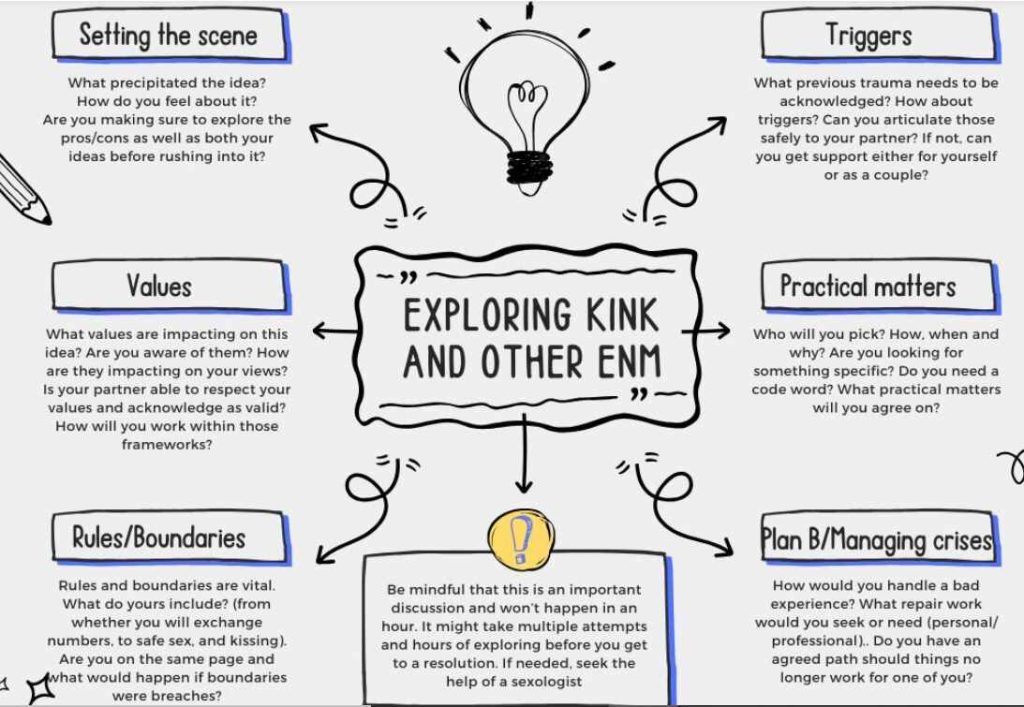
Whether meeting partners in person or through apps, emotional and physical safety should be woven into the structure from the start.
Sexual Health Agreements
Discuss STI testing frequency, barrier-use preferences, and disclosure timelines. Research from the Kinsey Institute indicates that individuals in consensual non-monogamy are often more proactive about testing and safer-sex negotiations, largely due to explicit communication.
Clear Logistics
Share reasonable details such as date, locations, general timeframes, and safety check-ins. This is not about surveillance; it’s about ensuring everyone feels secure while respecting privacy.
Emotional Aftercare
After significant milestones—like a partner’s first date or deepening emotional bond—it helps to schedule grounding conversations. These exchanges create reassurance and allow space for questions, concerns, or celebration.
Protect Existing Relationship Quality
Healthy ENM should support stability, not diminish it. Maintaining intentional time together, upholding prior commitments, and continuing emotional investment ensure your foundational connection remains strong as new ones grow.