

















Most people don’t search for the term sexually compatible because they’re trying to “optimize” anything. They search for it because something feels uncertain.
Sometimes it’s subtle signs or prompts that bring about this feeling. You like this person, you respect them, and you can imagine building a life together. Yet when you’re alone, your body doesn’t quite settle.
Or it settles too much, in a way that worries you. Maybe you feel chemistry, but you don’t feel ease. Or you feel ease, but not much desire. And because you don’t want to judge too quickly, you start wondering what is normal, what can grow, and what you’ll regret ignoring.
Sexual compatibility is one of those topics people talk about loudly in theory and quietly in real life. It’s also one of the areas where we’re most tempted to pretend we can “figure it out later.”
That works sometimes. Other times it becomes the thing you avoid naming until it is too big to ignore.
In this article. We’ll help you notice the real signs, especially the soft ones. The ones you can feel in the room, not just in your head. And then it’s here to help you talk about it in a way that doesn’t turn the whole relationship into a performance review.
Because when people say “sexually compatible,” they’re usually talking about something broader than sex.
They’re talking about whether the relationship can hold honesty, desire, awkwardness, change, and care without anyone shrinking.
What Is Sexual Compatibility?
The word compatibility can sound clinical, as if you’re testing two devices to see if they connect. Yet in real relationships, sexual compatibility is less like a switch flipping and more like a shared language developing.
At the simplest level, being sexually compatible means your needs and rhythms overlap enough that both of you can feel wanted and safe at the same time. It means neither of you has to force yourselves into a version of sex that doesn’t suit you, just to keep the peace.
It means sex doesn’t become a recurring source of quiet dread, shame, or bargaining.
Still, compatibility is not only about frequency. It’s also about pace and how you handle vulnerability. It’s about whether one of you treats sex as a connection while the other treats it as a chore or a scoreboard.
Equally crucial, it’s about whether you can speak plainly when something feels off without being punished for it.
That’s why chemistry and compatibility aren’t the same thing.
Chemistry can be loud and immediate. It can also be misleading. Compatibility is often calmer, and as studies show, it plays a crucial factor in determining the success of a relationship. It shows itself over time, especially in how you both respond when things aren’t perfect.
Signs You Are Sexually Compatible With Your Partner
People imagine sexual compatibility as a dramatic “yes” in the body, and sure sometimes it is. However, more often, it’s revealed in everyday moments that don’t look like anything from the outside.
It can show up in a pause.
It can show up in a way you relax, or don’t.
It can show up in whether your partner notices you—not as a concept, but as a person.
Part of being sexually compatible with your partner is in how the two of you relate. As such, some of the clearest signals appear before sex ever happens.
Ease matters more than sparkle
A lot of couples start with heat and then realize later that sex makes one or both of them anxious. Others start with gentle awkwardness and then build something good.
So, it helps to focus less on whether sex feels cinematic and more on whether it feels safe enough to learn about each other.
Pay attention to what your body does after you’re intimate. Do you feel calmer, or more unsettled? Do you feel closer, or oddly alone even while lying next to them? Do you feel like yourself, or like you were acting a part?
Those reactions aren’t “overthinking.” Instead, it is your body giving you signals of whether you are sexually compatible with your partner.
You can talk about sex without paying a price
One of the strongest indicators of sexual compatibility is also one of the least glamorous: the ability to speak about sex without it turning into defensiveness, shame, or silence.
If you can say, “Slower,” or “Not like that,” or “I’m not in the mood tonight,” and your partner stays kind, that’s a strong foundation fpr sexual compatibility.
In contrast, if every small adjustment is treated like criticism, you’ll start editing yourself. And when you edit yourself enough, sex becomes something you manage rather than something you share.
To be sexually compatible with your partner does not mean you are both perfect, but rather that compatibility isn’t perfection. However, it does require emotional steadiness.
Desire feels mutual, even if it isn’t identical
In most couples, one person wants sex more often. That isn’t automatically a problem. The issue is what the difference creates.

In sexually compatible relationships, both people still feel chosen. There’s a sense that desire moves both ways, even if the timing varies.
You might not initiate equally, yet you don’t feel like you’re begging for attention. And you don’t feel like you’re constantly dodging someone else’s need.
When a mismatch is present, it often feels like a quiet imbalance: one person becomes the “asker,” and the other becomes the “decider.”
Over time, that dynamic can harden. Then sex stops being intimate and starts feeling like a negotiation.
So notice the emotional temperature around initiation. Is there warmth? Is there pressure? Is there fear of rejection? Is there guilt?
Those are compatibility clues.
Curiosity is a better sign than confidence
You don’t need a partner who is “great in bed” in some universal way. You need a partner who is interested in your experience.
Curiosity looks like noticing what changes in you. It looks like being present, not rushing. It looks like a partner who can ask, softly,
“Is this good?” and mean it. Or one who can accept guidance without getting thrown off.
While confidence can be performative, curiosity is collaborative. And sexually compatible couples tend to collaborate naturally.
Boundaries are respected the first time
This is simple, but it’s also where many people talk themselves out of the truth.
If you say no to something, and this could be anything, and your partner pouts, pressures, repeatedly revisits it, or acts wounded, that’s not a minor mismatch. It’s a warning.
Sexual compatibility includes how someone handles your limits. Not just whether they hear you, but whether they honor you.
In healthy, sexually compatible dynamics, boundaries don’t kill desire. They protect it and allow you to relax, which is often what makes genuine desire possible.
Awkward moments don’t become shame
Bodies are unpredictable. Sometimes, people get nervous,

and things don’t work the way they planned. Someone laughs at the wrong time. Someone needs to stop. Someone loses the mood. That’s real life.
When you’re sexually compatible, those moments don’t become a story about failure. You recover together.
There’s a gentleness in the room, and an opportunity to try again another day without tension.
If, instead, awkwardness turns into embarrassment, anger, or icy distance, it becomes harder to be fully present.
And once you feel like you’re being graded, desire tends to retreat, and it is a core sign you’re sexually incompatible.
You feel more like yourself over time, not less
This is one of the quietest signs, and it matters.
In a sexually compatible connection, intimacy doesn’t make you disappear. It doesn’t require you to become “cooler,” “wilder,” “less needy,” or “more easygoing” than you are.
It invites you to be more honest. And that honesty feels safe enough to carry.
If you notice you’re doing a lot of emotional labor like monitoring their reactions, managing their ego, rehearsing how to bring things up, sex will eventually feel heavy. Even if it looks fine from the outside.
Sexual compatibility does not end at what happens in bed. It’s about whether intimacy makes you more alive or more careful.
Sexual Compatibility Mismatches That Quietly Grow Bigger
Some differences are workable. Others become chronic friction. What makes the difference isn’t the mismatch itself, but how the two of you meet it.
Here are a few common mismatches that often sit underneath the search for sexually compatible, especially when someone is trying to decide whether to commit.
The Libido Gap
One partner wants sex frequently, while the other could take it or leave it. At first, it might seem like a simple compromise issue.
Yet over time, it can turn into something more emotional: one person feels unwanted, the other feels pressured.
If the higher-desire partner starts measuring love through sex, and the lower-desire partner starts feeling they must “perform” to keep the relationship stable, resentment creeps in quietly.
This mismatch can be navigated. Still, it requires kindness and honesty from both sides, not a silent tug-of-war.
Different styles of intimacy
One person wants slow, emotionally connected sex. The other wants playful intensity or novelty. Neither is wrong.
Yet if you consistently miss each other’s pace, sex can start to feel like you’re speaking different dialects.
It’s not only about what you do. It’s about what sex means to each of you in the moment.
In sexually compatible relationships, you can adjust your style without feeling like you’re betraying yourself. In incompatible ones, you feel like you’re always compromising something central.
Mismatch in aftercare and closeness
Some people want touch and closeness afterward. Others want space, sleep, or quiet. This can sound small until you live it.
If you need reassurance and your partner immediately rolls away, you may start feeling emotionally stranded.
On the other hand, if you need space and your partner clings, you may start feeling trapped.
This isn’t about who is right. It’s about whether your needs can coexist without someone feeling abandoned or smothered.
Different comfort with exploration
Some people prefer a familiar pattern. Others want variety, experimentation, or kink. Sometimes, couples can find a middle ground.
Other times, one person feels chronically restrained, while the other feels chronically pushed.
What matters here is not the label. It’s the emotional tone. Are requests made with respect, and received without fear? Or does the topic carry pressure, judgment, or insecurity?
Value mismatches
Even in loving relationships, values can create sexual incompatibility. Differences around monogamy, porn, flirting, contraception, religion, or timing can shape how safe intimacy feels.

These are not “small personal preferences.” They often touch identity, trust, and stability. So it’s better to see them clearly rather than assuming love will smooth them out.
How to Assess Sexual Compatibility Without Turning It Into a Test
People often try to assess sexual compatibility by analyzing one experience. That rarely works. Real compatibility shows up in patterns, and patterns show up over time.
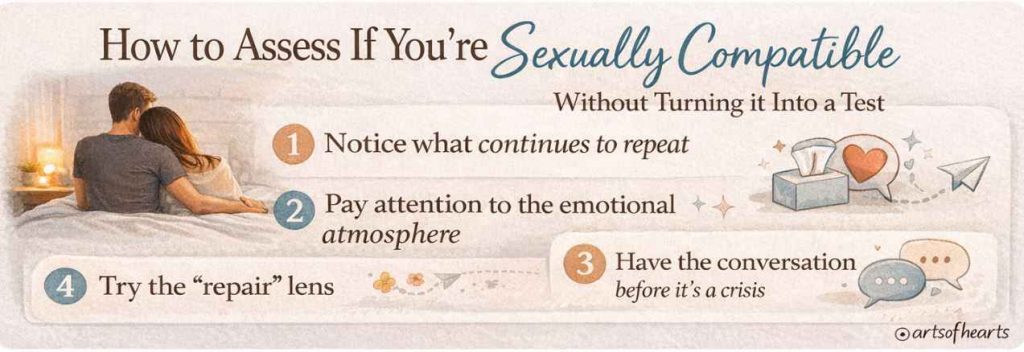
So instead of chasing certainty, look for clues you can trust.
Notice what repeats
If sex feels off once, it may be nerves, timing, stress, alcohol, or unfamiliarity. That happens. If it feels off repeatedly and in the same direction, that’s worth paying attention to.
For example, if you repeatedly feel rushed, or ignored, or pressured, that isn’t a “bad night.” It’s likely a real mismatch in pace or care.
Similarly, if you repeatedly feel disconnected afterward, or you repeatedly avoid initiating because you fear how it will go, that’s a pattern too.
Patterns tell the truth gently, if you let them.
Pay attention to the emotional atmosphere, not just the act
You can have technically “good” sex and still feel unsettled.
Sometimes the sex is fine, yet the emotional environment is wrong. Maybe you feel like you can’t say no without consequences.
Maybe you feel you have to protect their ego. Maybe you feel you can’t ask for what you need. Those things erode desire quietly.
On the other hand, you can have clumsy, imperfect sex and still feel safe, seen, and cared for. That kind of safety often leads to better sex over time.
Have the conversation before it becomes a crisis
This is where many people stall, because they want it to feel spontaneous and effortless. Yet the truth is, most healthy couples talk about sex at some point. Not in a dramatic “we need to talk” way. More like two adults comparing notes so nobody has to guess.
You can keep it simple and human.
You might say something like:
“I like being close with you. And I want us to understand each other, instead of assuming. Can we talk about what helps you feel comfortable and wanted?”
That isn’t clinical. It’s caring.
From there, a few gentle topics reveal a lot:
- What does a good sex life look like to you in a relationship?
- How often do you usually want sex when things are going well?
- What makes you feel desired?
- What makes you shut down quickly?
- Are there any hard boundaries I should know early?
- How do you like to be approached when you’re not in the mood?
You don’t need to cover everything in one sitting. In fact, it often goes better when it’s not one big interview. A few honest conversations over time tend to create more truth than one intense talk.
Try the “repair” lens
One of the clearest ways to assess whether you and your partner are sexually compatible is to see what happens after a misstep.
Every couple will have a moment where something feels wrong. Maybe someone moves too fast. Maybe one person freezes. Maybe the mood shifts. Maybe someone says something clumsy.
In compatible dynamics, repair is possible. The other person doesn’t make it about them. They don’t punish you. They stay present. They adjust.
If repair is consistently absentif the response is sulking, blame, avoidance, or making you feel dramatic, then the mismatch will likely grow.
Repair is where compatibility becomes visible.
Are You Sexually Compatible: What’s Fixable, and What Tends to Stay Painful
It’s tempting to label any problem as incompatibility. It’s also tempting to label any incompatibility as something you can “work through.” The truth sits in the middle.
Some things improve with time, trust, and learning. Other things keep hurting because they’re rooted in disrespect, avoidance, or incompatible values.
Often fixable with goodwill
If you like each other and there’s baseline care, many early issues can soften:
- Awkwardness in the beginning
- Different preferences that you can learn
- Shyness about giving feedback
- Temporary changes due to stress, grief, health, or medication
- Anxiety that decreases as safety grows
In these cases, sex might not be perfect yet, but it feels hopeful. There’s room to grow without pressure. You can use the following tips to help you revive or grow romance and avoid roommate syndrome.
Less fixable, because the issue isn’t sex
Some patterns are not “technique” problems. They are relationship problems showing up through sex.
For instance:
- Pressure when you say no
- Guilt, sulking, or entitlement
- Mocking or dismissing your preferences
- Refusing to talk, learn, or adjust
- Repeated disregard for consent
- Using sex as control, punishment, or leverage
If the emotional environment is unsafe, sexual compatibility usually cannot be built. Even if the chemistry is intense.
In other words, for you and your partner to be sexually compatible, you need kindness. Without that, you’ll always be managing instead of connecting.
If You’re Not Sexually Compatible, You Still Have Choices
Sometimes you’ll read this and realize the mismatch is there, but it isn’t cruel. It’s just real.
If that’s your situation, you don’t have to rush into a dramatic decision. Still, you also don’t want to pretend it doesn’t matter.
One option is to name the mismatch gently and see whether your partner engages with it. Not with grand promises, but with consistent care. If you can find overlap—frequency that feels fair, initiation that feels mutual, boundaries that feel respected—compatibility can become something you build.
Another option is to seek support together, especially when the issue involves pain, anxiety, erectile difficulty, trauma triggers, or major life transitions. Sometimes the problem is not the relationship. It’s a combination of stress, misunderstanding, and silence.
And sometimes, the honest answer is that the mismatch will cost too much over time. If sex repeatedly leaves one of you feeling unwanted or pressured, the relationship may become a place where you both feel small. Ending things kindly can be an act of respect, not failure.
You’re allowed to take sexual compatibility seriously. It doesn’t make you shallow. It makes you honest about what sustains a relationship in the long run.
A Quiet Sexually Compatible Checklist You Can Trust

If you want a grounded way to take stock, focus on these essentials;
- You feel safe bringing up needs.
- Your “no” is respected immediately.
- You feel desired more often than rejected.
- You can recover from awkward moments without shame.
- There is enough overlap in preferences and values.
- When you talk, things improve rather than tighten.
Those aren’t fancy metrics. Yet they predict whether intimacy will become a comfort or a conflict.
Knowing Where You Stand
Sexual compatibility is rarely a single yes-or-no moment. It’s often a series of small realizations. You notice whether you can relax. You notice whether you’re listened to. You notice whether desire has room to breathe rather than being squeezed into obligation.
And because commitment magnifies whatever is already there, it helps to look closely before you build a future around the hope that one day it will feel different.
If you’re sexually compatible, you don’t just have “good sex.” You share a mutual atmosphere. Such an environment is where honesty doesn’t scare either of you, where intimacy doesn’t require you to hide, and where both people can be genuine, even when things aren’t perfect.


