
















Some relationship advice feels like it belongs to people with unlimited time, perfect communication, and a life that never gets messy. Real couples live in the middle of things. Work spills into evenings. Someone forgets to reply. A small comment lands the wrong way. The love is there, yet the ease comes and goes. That’s why the focus should equally be on the small or simple habits that make a relationship strong.
The reality is that what strengthens a relationship most often is not a dramatic gesture. It’s the quiet habits that keep you close when you could easily drift. The ones that don’t look impressive to anyone else, yet they change the feeling in the room. These are habits that make a relationship strong because they build safety, warmth, and steadiness in ordinary moments.
You might notice something as you read. Many of these habits are less about doing more and more about doing things sooner, softer, and with a bit more care.
Why These 17 Habits That Make a Relationship Strong Actually Work
Strong couples usually share one invisible skill. They don’t let small damage sit around long enough to become a story. They repair quickly. They return to each other. They protect the “us” even during stress.
These habits that make a relationship strong also work because they are simple enough to repeat. Big promises tend to fail on tired days. Small habits keep showing up. Over time, that repetition becomes trust.
A relationship grows stronger when both people feel understood more often than they feel managed. A lot of modern advice pushes communication as a performance.
Real closeness comes from small moments of emotional accuracy. You see what’s happening. You respond in a way that fits. Your partner feels met, not handled.
17 Surprisingly Simple Habits That Make a Relationship Strong
1. Repair a sharp moment quickly
A relationship doesn’t break from one tense sentence or moment, but it weakens when nobody circles back.
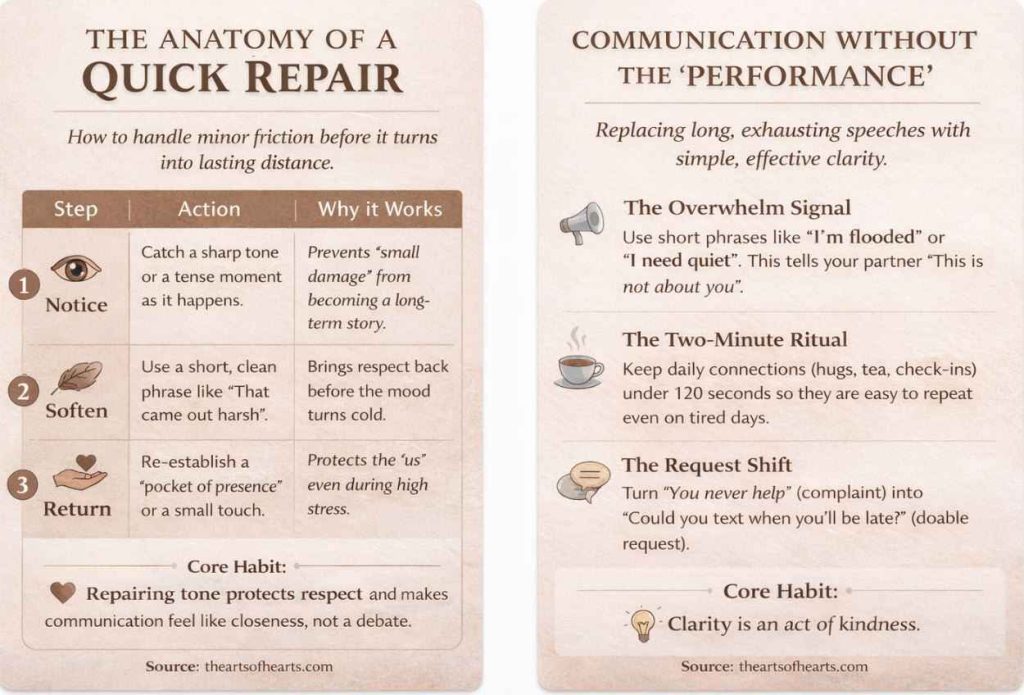
A quick repair doesn’t take much and can be almost plain: “That came out harsh. I’m sorry.” The point is not to erase what you meant but rather bring respect back into the space before the mood turns cold.
When this becomes normal, both of you stop bracing for the next blow.
2. Use a short phrase that means “I’m overwhelmed”
Many arguments start because one person thinks they’re being rejected, while the other is simply overloaded.
A simple phrase creates clarity without drama. “I’m flooded.” “I need quiet.” “I’m at my limit.” It tells your partner, “This is not about you,” and it prevents them from filling the silence with assumptions.
This is one of those relationship habits for couples that feels almost too small to matter, yet it has significant implications.
3. Say appreciation in the moment, not later
Some people think gratitude should be obvious. However, over time, the obvious becomes invisible.
Noticing out loud changes that. “Thank you for handling that.” “I felt taken care of when you did that.” Short sentences especially land best because they don’t feel like a performance.
This is one of the habits that make a relationship strong because it keeps the effort from feeling taken for granted.
4. Keep a daily ritual under two minutes
A long ritual is easy to drop because of other life demands so a short one will work best. The options here are varied, giving you enough to style your relationship.
A slow hug before leaving. A real hello when someone walks in. A shared cup of tea. A quick check-in in bed. Daily habits for a strong relationship often look like this. They are small, yet they put a thread through the day.
5. Ask for comfort plainly
People often ask for love in a disguised way. They complain, tease, or go quiet, which can be very confusing for their partners.
A stronger habit is saying what would actually help. “Could you hold me for a minute?” “I need reassurance.” “Can we talk without fixing it right now?” Many partners want to show up, yet they don’t know how.
You should consider clarity an act of kindness.
6. Retire one recurring argument
Every couple has a topic that never ends, and it just keeps returning in different outfits.
Retiring it means deciding that the relationship is more important than being right about this one thing. Practical workarounds help. You could separate routines, opt for simple agreements, or lower expectations in a specific area. A tiny shift can remove a huge amount of tension.
This is one of the most overlooked healthy relationship habits because it requires pride to soften. It also helps prevent toxic relationship patterns.
7. Sit together while doing separate things
Experiencing closeness does not always need conversation. In fact, many couples feel best when they share space without pressure.
Reading, cooking, working, scrolling quietly, folding laundry side by side. It sounds ordinary because it is ordinary. That ordinary presence builds connection.
A strong relationship often has plenty of quiet companionship.
8. Say “I was wrong” without explaining for ten minutes
A clean apology lowers the temperature, while a long explanation often sounds like self-defense.
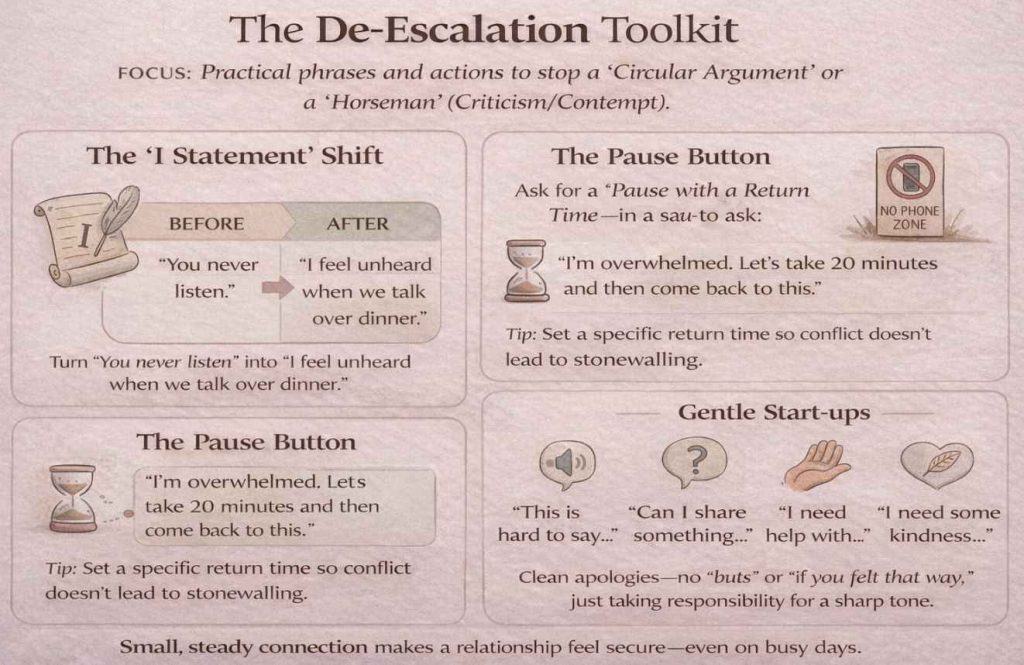
A short one sounds like care. “I misunderstood.” “I shouldn’t have said it that way.” “You’re right.” Let the sentence end there.
Trust grows when accountability feels safe.
9. Pause conflict without disappearing
People don’t always fight because they want to hurt each other. Many fights happen because both people get overwhelmed at once.
A pause works when it includes a return. “I need twenty minutes, then I’ll come back.” The return is the part that keeps the relationship from feeling unsafe.
This habit prevents escalation, and it protects the bond while the feelings cool down.
10. Protect each other in public
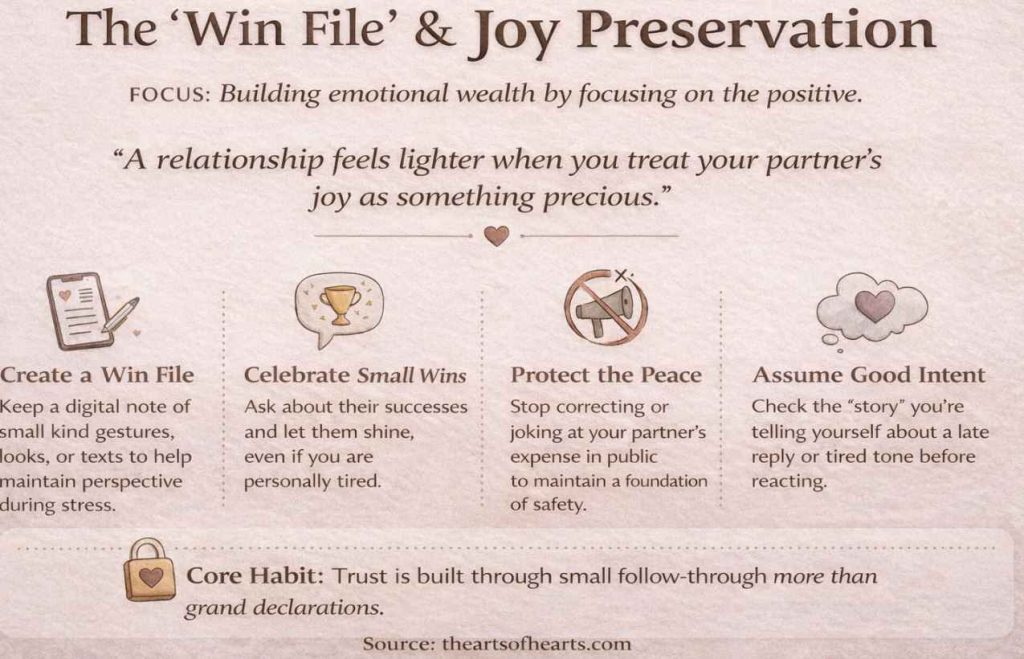
Public embarrassment lingers long after the event. So, even if correcting your partner in front of others, or joking at their expense, might seem harmless in the moment, it changes how safe they feel with you later.
A strong couple has each other’s back in rooms where it would be easy not to.
11. Keep a simple “win file”
Most couples remember what hurt, and few intentionally remember what helped.
A win file can be a note on a phone with small moments: the time they brought you a snack, the kind text, the look across the room. It is a stabilizing action that helps you see the road perspective. When life gets tense, this habit reminds you that love has been present in more ways than your stress is letting you see.
12. Turn complaints into doable requests
A complaint often sounds like a character attack, even when it isn’t meant that way. A request, on the other han,d gives your partner a clear place to step in.
“Could you text when you’ll be late?” “Could we pick one night a week for just us?” “Please don’t tease me about that.”
Habits of strong couples include speaking in a way that makes success possible.
13. Check the story you’re telling yourself
Distance creates stories. For example, a late reply becomes, “I’m not important.” A tired tone becomes, “They don’t care.” A habit that strengthens a relationship is naming that story gently. “My mind is telling me you’re upset with me.” “I’m starting to feel ignored.”
Real-world behavior is messy, and oftentimes a story can be wrong. Clarity saves time and prevents unnecessary pain.
14. Keep one phone boundary that protects attention
Most couples don’t need a strict regime. All they need is one protected pocket of presence.
This could be dinner without screens, the first fifteen minutes after work, or bedtime. The smallest boundary often creates the biggest emotional shift because attention is one of the clearest forms of love.
This is a surprisingly simple habit that makes a relationship strong in a noisy world.
15. Make your bids for connection easy to accept
Connection bids fail when they feel like pressure and an obligation to the other party. A softer bid invites closeness.
For example, “Sit with me for five minutes.” “Come look at this.” “Let’s take a short walk.” These moments build a steady sense of friendship, not a relationship that only comes alive during serious talks.
16. Repair tone as soon as you notice it
The tone used in speech can injure even when the words are fine.
Fortunately, a calm reset matters: “My tone was sharp.” “I’m not trying to disrespect you.” Respect is not only what you do. It’s how you do it.
This habit keeps love from being eroded by small daily abrasions.
17. Treat your partner’s joy as something precious
Many people know how to show up for pain, but struggle when it comes to joy often brushing it.
Celebrating your partner’s happiness builds closeness. Ask about their win and let them shine. Share their excitement even when you’re tired. This is how a relationship feels lighter again.
It’s hard to feel distant from someone who feels like a safe place for your good news.
How to Turn Habits That Make a Relationship Strong Into a Routine
Most people fail at relationship change because they try to fix everything at once. A better approach is smaller, slower, and more honest.
Choose two habits that make a relationship strong for one week. Pick one that adds warmth, and one that reduces friction. A two-minute ritual plus quick repairs can change the feel of a relationship more than a long conversation about what’s wrong.
Let the habits be visible. Not performative, visible. Name what you’re doing in a simple way. “I’m trying to repair faster.” “I want us to have a small daily moment.” It helps your partner understand your intention, and it keeps the habit from feeling random.
Consistency is what makes this work. Strong relationships are often built by people who keep returning to the basics even after a rough day.

Quick Takeaway From Habits That Make a Relationship Strong
A relationship becomes stronger in a quiet way; things become normal. Warmth stops feeling like something you have to earn, and repairs happen before tension has time to settle into distance.
The small rituals start to steady you, especially on the days that feel rushed or heavy. Clear requests save you from the slow build of resentment, and simple accountability keeps respect from getting chipped away.
Attention, protected in small pockets, brings back a sense of closeness that doesn’t need to be forced. Joy, shared and welcomed, reminds you that love is allowed to feel light, too.
These are habits that make a relationship strong because they hold up in real life, inside the ordinary moments where a relationship is actually lived.
FAQ About Habits That Make a Relationship Strong
What are the best daily habits for a strong relationship?
Daily habits for a strong relationship usually look simple from the outside. A real greeting. A short check-in. A small moment of attention that is not competing with a phone. The best daily habits are the ones you can still do when you’re tired.
A two-minute ritual matters because it builds continuity. It tells both people, “We still belong to each other,” even during busy seasons. Add quick repairs after minor tensions, and the relationship starts to feel safer again.
What habits make a relationship strong when life gets stressful?
Stress changes people. It shortens patience. It reduces tenderness. It makes small problems feel personal.
During stressful periods, the strongest habits are the ones that prevent misinterpretation. A short phrase that signals overwhelm. A time-bound pause during conflict. A quick repair after a sharp moment. These habits keep stress from becoming a personality in the relationship.
What habits build trust in a relationship over time?
Trust is built through small follow-through more than grand declarations.
Doing what you say you’ll do creates reliability. Protecting each other socially creates loyalty. Apologizing cleanly creates safety. Showing up for your partner’s joy creates warmth. Over time, these become proof points that the relationship is steady.
How can couples stop fighting about the same things?
Repeated fights often come from one unresolved feeling that keeps finding new topics.
Retiring one circular argument can be a turning point. Name the loop gently, then choose a workaround that protects the relationship from constant friction. A pause with a return time helps too because it keeps conflict from becoming damaging.
Over time, the goal becomes fewer escalations, not zero disagreements.
What are healthy relationship habits that improve communication naturally?
Communication improves when it feels safe, not forced.
Short, clear sentences land better than long speeches. Timing matters more than intensity. Asking for what you need reduces mind-reading. Repairing tone protects respect. These habits make communication feel like closeness, not a debate.
What are simple habits that improve intimacy without pressure?
Intimacy grows when attention returns. This could be through a protected pocket of presence, a touch in passing, parallel time, and making connection bids small and easy. These are simple habits that strengthen a relationship because they rebuild closeness without making anyone feel managed.