
















Most people think communication problems are about words. Yet, they’re usually about the feeling underneath the words. They stem from the sense that you’re not safe to be honest, not sure you’ll be understood, or tired of repeating yourself.
If you’re asking, “How do I communicate better with my girlfriend/wife?” that’s already a good sign. It means you’re trying to get your point across, but equally, you’re trying to build something steady.
And steady communication doesn’t come from having perfect phrasing. It comes from learning how to stay present when it would be easier to shut down, attack, or retreat into silence.
A helpful way to frame it is this: you’re not trying to “win” conversations. You’re trying to make your relationship feel like a place where truth can survive. Truth spoken clumsily, truth spoken late, truth spoken with some fear is still truth.
Below are practical, human shifts that make communication feel easier, especially when emotions run hot.
A small shift that changes everything
Before we get into techniques, it helps to name the primary enemy: the urge to defend yourself.
Defensiveness is natural. If you feel accused, you want to prove you’re not the villain. If you feel misunderstood, you want to correct the record. If you feel like your effort isn’t being seen, you want recognition.
But in relationships, defensiveness has a cost. It tells your partner, “Your feelings are a threat.” And once feelings are treated like threats, the conversation stops being about understanding and becomes a trial.
A calmer goal sounds like this:
“I want to understand what this feels like for you, and I want you to understand what it feels like for me.”
That’s the heart of better communication, and everything else is just practice.

How to communicate better with my girlfriend when we’re already tense
There’s a specific moment most couples miss is which is the moment the conversation becomes unsafe.
It often happens fast, starting either with a change in tone, a sigh, or a sarcastic comment. Someone says, “Here we go again,” and suddenly you’re not discussing the issue, you’re defending your dignity.
When you notice that shift, do this first: slow it down.
Try something like:
- “I want to talk about this, but I can feel myself getting worked up. Can we slow down for a second?”
- “I’m not trying to fight you. I’m trying to understand what’s bothering you.”
- “Give me a minute. I want to respond well, not react.”
This is a mature, non-dramatic approach. It also means you are choosing connection over momentum.
Also, don’t start hard conversations at the worst times, like when one of you is hungry, exhausted, rushing, or already irritated. Waiting for the right time is an excellent strategy that does not translate to avoidance.
If you want a simple rule: talk when you can be kind.
How to communicate better with my girlfriend without sounding defensive
Defensiveness often sounds like:
- “That’s not what happened.”
- “You’re overreacting.”
- “I didn’t mean it like that.”
- “So you’re saying I’m a bad boyfriend/husband?”
Even if you’re trying to clarify, it can land as dismissal.
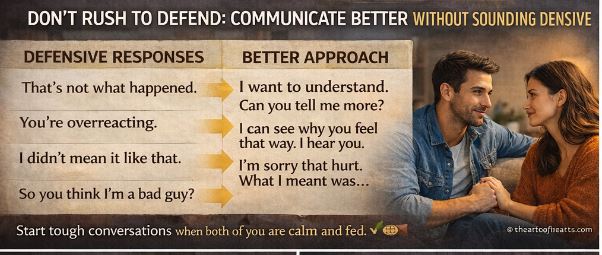
A better approach is to start with impact, then add context.
Instead of: “I didn’t mean it like that.”
Try: “I can see how that would hurt. I’m sorry. What I meant was…”
Instead of: “You’re being unfair.”
Try: “I feel misunderstood right now, but I want to get this right. Can I tell you how I experienced it?”
Instead of: “I already do so much.”
Try: “I hear you saying you need more from me. Can we talk about what ‘more’ would look like specifically?”
This does two things:
- It keeps the emotional door open.
- It makes problem-solving possible without either of you losing face.
How to communicate better with my girlfriend about needs and expectations
As research shows lot of conflict is just unspoken expectations finally speaking loudly.
One person thinks, “If you loved me, you’d automatically…”
The other person thinks, “If you needed that, why didn’t you say so?”
Neither is evil. Both are human.
The key is learning how to turn complaints into requests.
A complaint sounds like:
“You never spend time with me anymore.”
A request sounds like:
“I miss you. Can we plan one intentional evening together this week—phones away?”
A complaint sounds like:
“You don’t care about what I’m dealing with.”
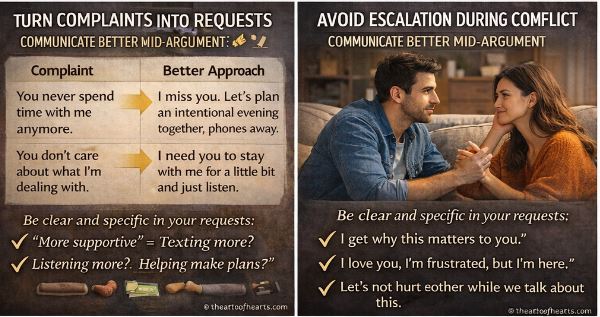
A request sounds like:
“I need you to ask me questions and stay with me for a bit instead of trying to fix it.”
When you speak in requests, you give your partner something to succeed at.
Also, be careful with vague language: “You should be more supportive.”
Supportive how? Texting more? Listening longer? Helping with logistics? Reassurance?
Being specific provided clarity and should not be confused with wanting to control.
How to communicate better with my girlfriend during conflict
Conflict is where couples reveal their real communication style. Tense moments provide a more accurate picture than in sweet ones, where everything is going well for everyone, and there is no diverging view.
A few principles make conflict safer:
Stick to one topic
When you bring up three months of resentment in one conversation, it stops being a conversation and becomes a pile-on.
Pick one issue, stay on it and finish it, or discuss it at least enough to understand each other, then move on later.
Avoid global statements
Words like “always” and “never” make your partner defend themselves, because they can instantly think of exceptions. And now you’re arguing about examples instead of feelings.
Instead of “You never listen,” try:
“When I was talking earlier, I felt unheard.”
Make repair attempts early
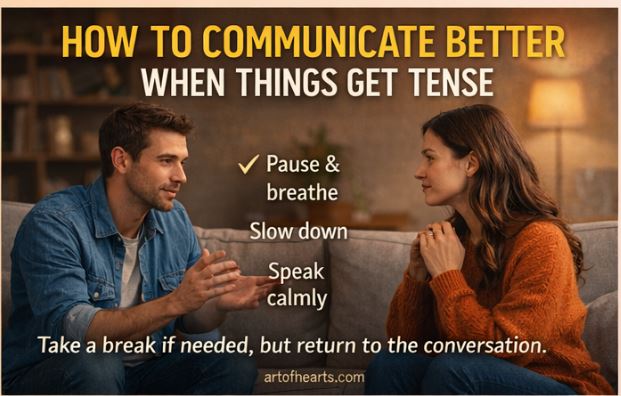
A repair attempt is any small move that says, “I’m still on your side.”
It can be:
- “I get why this matters to you.”
- “I love you. I’m frustrated, but I’m here.”
- “Let’s not hurt each other while we talk about this.”
Repairs prevent the conversation from turning into emotional damage.
Know when to pause
Sometimes the best communication is stopping before you say something that can’t be unsaid.
A strong pause sounds like:
- “I’m getting too heated. I need 20 minutes, and then I’ll come back.”
- “Let’s pause and return to this tonight after dinner.”
The “return time” matters. It keeps the pause from feeling like abandonment.
How to communicate better with my girlfriend when she says, “You don’t listen.”
When a woman says, “You don’t listen,” she may not mean you literally didn’t hear words. She may mean:
- “You rush to solutions.”
- “You minimize what I feel.”
- “You’re physically here but mentally elsewhere.”
- “You argue with my emotions instead of making room for them.”
A powerful response is to reflect before responding.
Try:
- “Okay. Tell me what felt missing when you were talking.”
- “What did you need from me in that moment—comfort, agreement, action?”
- “I want to understand. Can you say it again, and I’ll just listen first?
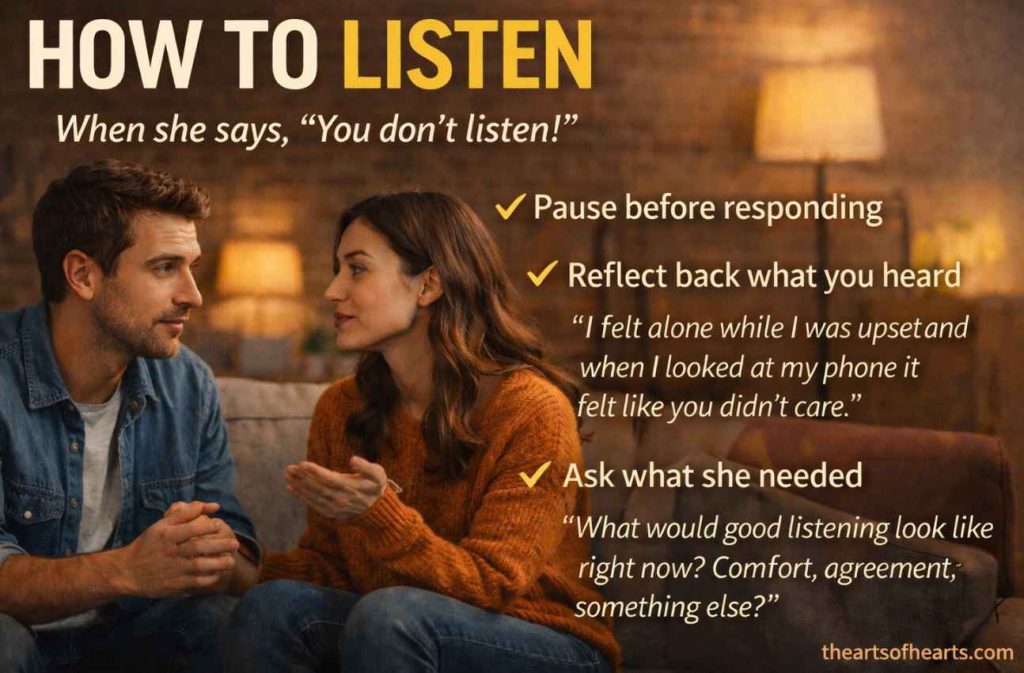
Then do something surprisingly effective: repeat back what you heard in your own words, without correcting it.
Example:
“So you felt alone with that stress, and when I looked at my phone, it felt like I didn’t care.”
You’re not confessing to being a bad partner. You’re showing you understand the experience.
If you disagree, you can add your perspective after she feels heard. The order matters.
How to communicate better with my girlfriend in day-to-day life
Most communication problems don’t start with big fights. They start with small disconnections that stack up quietly.
A few habits help prevent that buildup:
Do brief daily check-ins
Not an interrogation. Just a moment.
- “How are you, really?”
- “What’s been on your mind today?”
- “Is there anything you need from me this week?”
Five minutes of real attention can save you from an hour-long argument later.
Offer appreciation that’s concrete
Instead of “You’re amazing,” try:
- “I noticed how you handled that call. I respect your calm.”
- “Thank you for making the house feel good today.”
- “I feel lucky when you laugh like that.”
Specific appreciation lands deeper because it feels seen.
Don’t save everything for “the talk”
If the only time you communicate seriously is during conflict, then serious communication starts to feel like danger.
Share small truths casually:
- “I’ve been anxious lately. I don’t want it to spill onto you.”
- “I miss you. I want us to have more us-time.”
- “I felt a little dismissed earlier. Can we reset?”
Small honesty keeps the relationship breathable.
If communication keeps failing
Sometimes you do “everything right,” and it still feels like you’re speaking different languages.
In that case, look for patterns like:
- One of you avoids hard conversations until it explodes
- One of you criticizes while the other shuts down
- Conflicts never get resolved, just recycled
- Apologies happen, but behavior doesn’t change
- You feel lonely even when you’re together
If you recognize that, don’t interpret it as hopeless. Interpret it as a signal that you need new tools, not more effort.
A calm option is to bring in support like a couples counselor, a structured communication course, or even a trusted mentor couple. Not because your relationship is broken, but because you don’t want to keep practicing the same painful loop.
Closing thoughts on How do I communicate better with my girlfriend/wife
The real answer to “How do I communicate better with my girlfriend or wife?” is this: make it safe to be honest on both sides.
Not safe as in “no conflict.” Safe as in “we can disagree without disrespect.” Safe as in “we can be messy and still be loved.” Safe as in “we return to each other.”
You don’t need perfect words. You need steadiness, humility, and the willingness to listen past your own fear of being wrong.
That’s where better communication starts. And, over time, it becomes the kind of relationship you can actually rest inside.


