
















Wanting emotional closeness is not a small thing. When you’re with a man who keeps his inner world locked up, it can feel like you’re dating a version of him that never fully arrives. This is why many women are always looking for advice on how to get him to open up emotionally.
You might get competence, loyalty, attraction, and shared routines, yet still feel alone inside the relationship.
If you’re searching for how to get him to open up emotionally, you’re probably not asking for constant therapy sessions or dramatic declarations. You’re asking for something simpler and deeper: honesty, softness, and the sense that you’re trusted with what’s real.
Here’s the truth from years of watching couples try to solve this the hard way: you cannot force emotional openness.
But you can absolutely make it easier for it to happen, more likely to last, and safer to grow while also protecting yourself from staying too long in a relationship that never becomes emotionally mutual.
How To Get Him To Open Up Emotionally Starts With Understanding What “Open” Really Means
Many women picture emotional openness as talking for hours, naming feelings easily, or offering reassurance on demand. Some men do express love that way, but plenty don’t—especially if they were raised to treat emotion as either weakness or inconvenience.
A man opening up emotionally often looks like this:
- He shares what’s weighing on him before it turns into irritability or silence.
- He can say “I’m overwhelmed” or “I’m worried,” even if he can’t fully explain why.
- He lets you see disappointment, doubt, tenderness, or fear without immediately changing the subject.
- He allows comfort—he doesn’t punish closeness when he’s vulnerable.
And just as important: opening up is not the same as dumping everything. A healthy relationship doesn’t require him to hand you his whole history in one sitting.
It requires a steady increase in access to his thoughts, emotional states, and needs, so you’re not building intimacy alone.
If you measure the wrong thing, you’ll end up pushing for speeches when what you really need is presence and honesty.
Why He Might Not Open Up Emotionally (And Why It’s Not Always About You)
When a man stays emotionally guarded, most women quietly blame themselves first: Maybe I’m too intense. Maybe I ask the wrong questions. Maybe he doesn’t love me enough. Sometimes that’s true, but often it’s incomplete.
Here are the most common reasons men hold back, without turning him into a diagnosis:
He learned that emotions were unsafe.
Some men grew up in homes where feelings were mocked, dismissed, or punished. They learned to survive by staying “fine,” staying capable, staying useful. Even if he loves you, that old wiring doesn’t disappear quickly.
He fears consequences.
Many men have experienced vulnerability being used against them later in conflict: “You said you were insecure, so…” or “You admitted you were struggling, so clearly you can’t…” If he believes opening up creates danger, he will protect himself.
He lacks the skill, not the desire.
Some men simply don’t have language for emotions. They feel stress in their body, agitation in their mood, fatigue in their appetite, but they can’t name what it is. When you ask, “What are you feeling?” they hear it as an exam they’re about to fail.
He processes internally.
Not every quiet man is emotionally unavailable. Some genuinely need time to make sense of what they feel before they can speak. If you require immediate emotional clarity, he may shut down to avoid disappointing you.
He doesn’t trust the relationship yet.
Trust is not only about loyalty. It’s about emotional safety over time: how you respond when he’s imperfect, how conflict is handled, how respect is maintained. If he senses a pattern of judgment, he may stay guarded even if he wants closeness.
Understanding the reason matters because it changes the approach. The same strategy that helps a slow processor will backfire with a man who fears humiliation, and the same patience that helps a man build trust can become self-abandonment if he’s simply unwilling.
How To Get Him To Open Up Emotionally Without Turning It Into Pressure
If you’ve tried to bring this up before, you might recognize the cycle: you reach for closeness, he feels cornered, he shuts down, you feel rejected, and the conversation becomes about the shutdown instead of the intimacy you were trying to build.
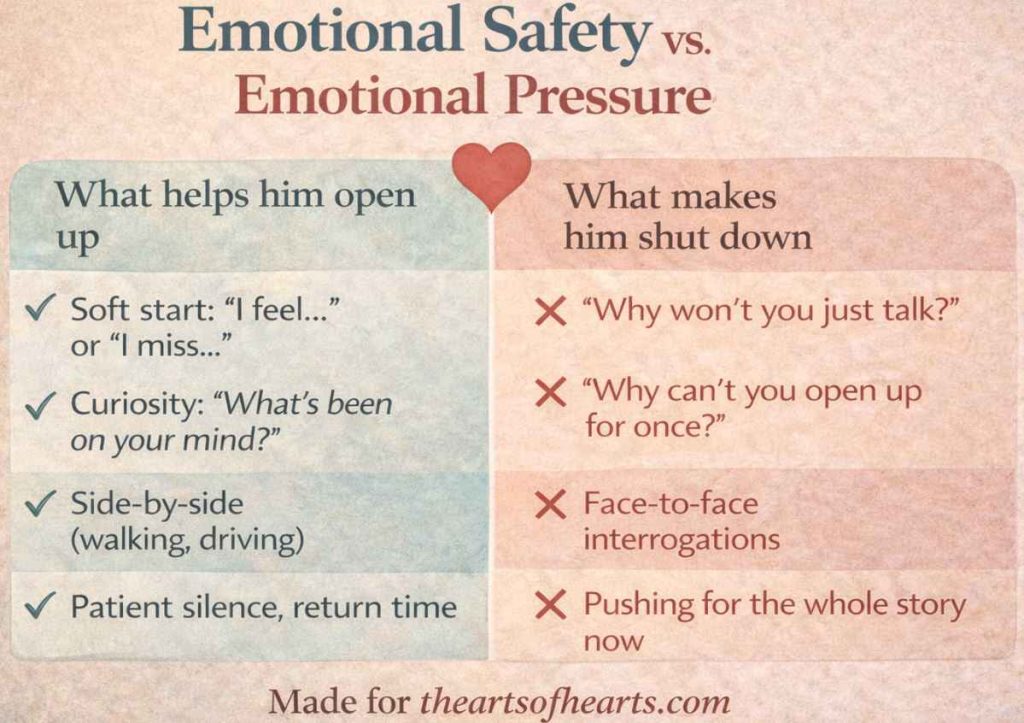
The biggest shift is moving from pressure to invitation.
Pressure sounds like:
- “Why won’t you just talk to me?”
- “You never open up.”
- “If you loved me, you’d share.”
Invitation sounds like:
- “I miss feeling close to you. Could we talk for a few minutes tonight?”
- “I’m not upset—I just want to understand you better.”
- “You don’t have to explain everything. Even a little would help.”
Pressure triggers defense because it implies failure. An invitation creates room because it implies partnership.
Timing also matters more than most people admit. Emotional conversations go best when he isn’t hungry, exhausted, rushing, or already bracing for conflict.
If you’ve only tried to talk about feelings when something is wrong, he will associate vulnerability with danger. Choose a neutral moment, and treat emotional closeness as part of the relationship and not a rescue mission.
How To Get Him To Open Up Emotionally By Asking Better Questions (And Fewer Of Them)
A common mistake is asking a lot of questions when you’re anxious. The intention is good as you are trying to connect, but the impact can feel like an interrogation.
Instead, ask fewer questions that are easier to answer.
Try questions that invite texture rather than a full emotional autobiography:
- “What’s been heavier than you expected lately?”
- “Is it more stress, frustration, or discouragement?”
- “What’s the part you haven’t said out loud to anyone?”
- “When you’ve been quiet, is it because you need space—or because you don’t know how to say it?”
These questions do two things: they offer emotional vocabulary, and they remove the expectation of a perfect explanation.
If he says, “I don’t know,” don’t treat it likea refusal right away. Often, “I don’t know” means: I haven’t sorted it yet. You can respond with a gentle bridge:
- “That’s okay. If you figure it out later, I’d like to hear it.”
- “Do you want me to sit with you or give you room?”
- “Would it help if I asked it a different way?”
When he’s not used to sharing, the goal isn’t to extract the full story. It’s to create a repeated experience where small honesty is met with respect.
What To Do When He Finally Shares Something Real (So He Doesn’t Regret It)
This is where many women unintentionally lose progress.
A man who rarely opens up is taking a risk. If that risk leads to criticism, panic, lecturing, or a fast jump into solutions, he may decide it wasn’t worth it. Not because he doesn’t care, but because he feels exposed. This action is an example of simple habits that make relationships strong.
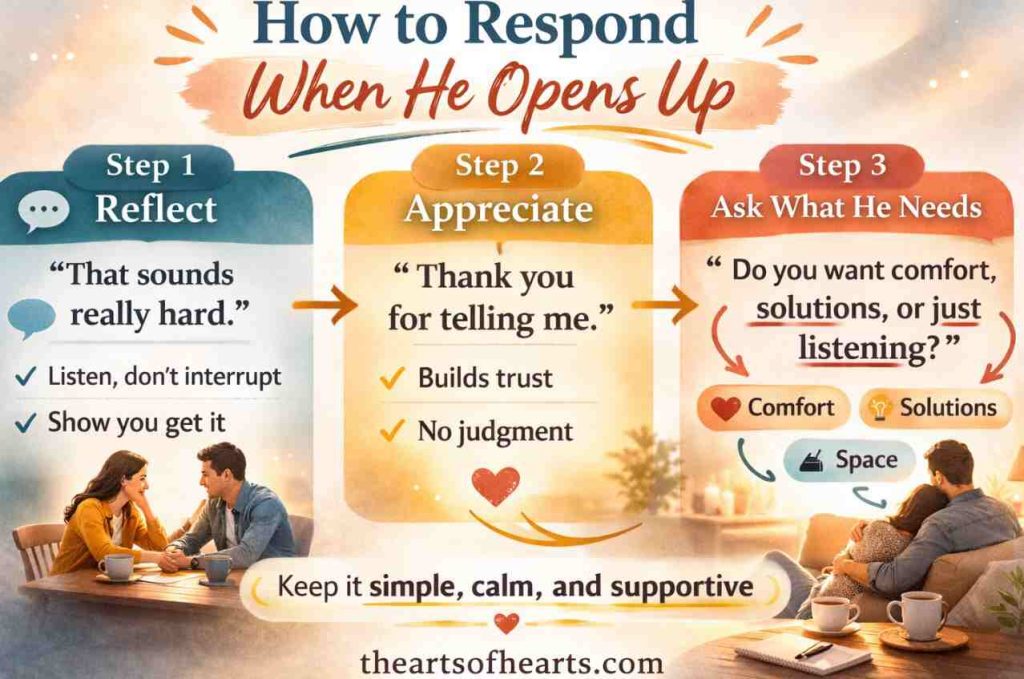
When he shares, try to respond in this order:
1) Reflect the emotion.
“That sounds exhausting.”
“I can see why that would weigh on you.”
2) Appreciate the openness.
“Thank you for telling me. I know that wasn’t easy.”
3) Ask what he needs.
“Do you want comfort, solutions, or just someone to listen?”
That last question is surprisingly powerful. Many men shut down because they assume feelings conversations will become complicated, endless, or performative.
When you keep it simple and ask what support looks like, you teach him that openness has a reward: relief, connection, steadiness.
Also, avoid “file keeping.” If he confides something vulnerable, don’t store it to use later in a fight. Nothing kills trust faster than emotional information becoming a weapon.
How To Get Him To Open Up Emotionally Through Everyday Intimacy, Not Just “Deep Talks”
A lot of emotional closeness is built outside the official conversation about closeness.
Men often open up more naturally when the setting is “side-by-side” rather than “face-to-face.” Walking, driving, cooking, doing errands—these reduce the intensity and help thoughts flow.
You can build a simple ritual that normalizes emotional sharing without turning it into an event:
The five-minute check-in
Once a day or a few times a week, ask:
- “What was the best part of your day?”
- “What was the hardest part?”
Keep it short. Stop before it becomes heavy. The goal is consistency, not intensity.
Another method that works well is modeling your own emotional language in small ways—without making him responsible for fixing it:
- “I felt a little insecure earlier, but I’m okay. I just wanted to be honest.”
- “I’ve been carrying stress. Being close to you helps.”
Modeling is not performing. It’s showing him that emotions can exist without drama. Over time, this quietly teaches him what a safe emotional environment feels like.
If he responds with action rather than words, making you tea, checking on you, doing something helpful, don’t dismiss it as “not emotional.”
Often, that is emotional expression in his native language. You can appreciate it and still ask for more verbal openness, but respect what he is offering as a bridge.
When He Shuts Down: How To Respond Without Chasing Or Punishing
Shutdown can look like silence, distraction, joking, irritation, or a flat “I’m fine.” When it happens, many women swing between two extremes: chasing harder or shutting down in return. Both usually deepen the distance.
A steadier approach is to name what you see without accusing:
- “I think this is getting hard to talk about. I’m not trying to corner you.”
- “I’m feeling the distance right now. I want to stay connected.”
Then offer a pause with a return time, so space doesn’t become avoidance:
- “Let’s take 20 minutes and come back at 8:30.”
- “We can stop for now, but I don’t want us to drop it completely.”
If he repeatedly refuses a return time, that’s important information. Occasional shutdown is human. Chronic stonewalling is a relational pattern that erodes intimacy.
How To Get Him To Open Up Emotionally Also Means Knowing When It’s Not Going To Happen
This part matters because hope can keep you in an emotionally one-sided relationship for years.
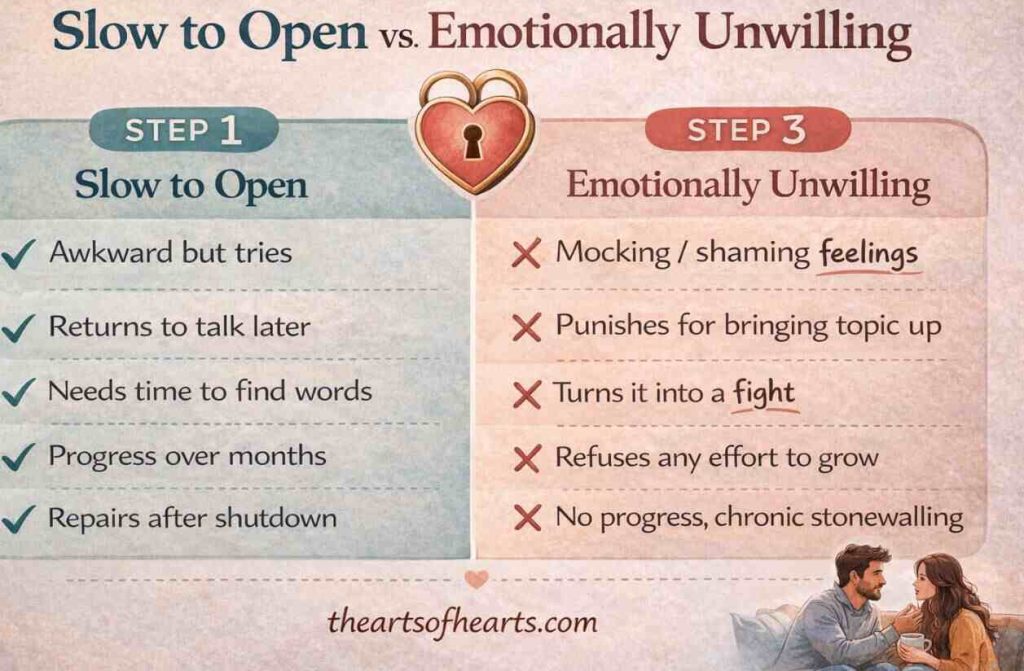
There’s a difference between a man who is slow to open and a man who is emotionally unwilling.
A slow opener may:
- Struggle to find words
- Need time
- Feel awkward
- Open up in small steps
- Show progress over months
An emotionally unwilling man may:
- Mock feelings conversations
- Punish you for bringing them up
- Dismiss your needs as “too much”
- Refuse any effort to grow
- Make you feel guilty for wanting closeness
If you’re consistently searching for how to get him to open up emotionally because nothing changes no matter how gently you approach it, the relationship may not be meeting a core need.
You are allowed to have standards here. Emotional intimacy is not a luxury. It’s how love becomes safe.
A clear boundary can sound like this:
“I care about you, and I’m willing to go slowly. But emotional connection matters to me. I need to see effort—not perfection, but effort—because I don’t want to be in a relationship where I feel alone.”
Notice what you’re looking for: not instant transformation, but willingness. Does he try? Does he return to the conversation? Does he show curiosity about your inner world too? Does he repair after shutting down?
If the answer is consistently no, then the question shifts from how to change him to what you’re choosing for yourself.
A Realistic Picture Of Progress (So You Don’t Expect Miracles Or Accept Stagnation)
Progress in getting him to open up emotionally is usually quiet. It looks like slightly longer conversations. Less defensiveness. More honest “I’m stressed” moments. A willingness to revisit a topic after cooling down.
Over time, you might see:
- He names feelings with less embarrassment
- He shares sooner, before resentment builds
- He asks you questions back
- He initiates a check-in occasionally
- Conflict becomes less about avoidance and more about understanding
If you see none of this over several months, despite your respectful approach, it’s fair to consider that he may not be capable or may not be interested in the kind of emotional partnership you want.
And if he is trying, acknowledge it. Men who didn’t learn emotional skills early often need reinforcement that they’re not failing simply because they’re learning late.
Closing: Closeness Is Built, Not Extracted
If you’re asking how to get him to open up emotionally, you’re not asking for perfection. You’re asking for a relationship where love includes honesty, softness, and mutual access.
Here is a recap of what to do: lead with safety, ask better questions, and respond well when he shares. Build intimacy in everyday moments, but remember to hold boundaries when avoidance becomes a pattern.
And remember: your desire for emotional connection is valid. The right man won’t make you feel foolish for wanting closeness. Even if he struggles, he’ll meet you with effort because he’ll understand that emotional intimacy isn’t pressure but the whole point of the relationship.


