

















Most men don’t struggle to say sorry because they don’t care, but because they never learned how to express regret without losing dignity. They do not know how to apologize correctly. It is not that they view saying sorry as a weakness, but rather most take it as admitting a lack on their end, and thus while trying to apologize, end up trying to justify their actions and applying reason to it, thus expecting their partners to understand where they are coming from. And that’s where they get lost and worsen everything.
From a young age, many men are taught to fix problems rather than feel them. They’re rewarded for being strong, rational, and decisive, but not for being emotionally open.
Yet in relationships, an apology isn’t about winning or losing but making amends and repairing injury. It’s not logic that heals wounds, but empathy.
“Couples who learn to repair after conflict are far more likely to stay together.”
— Dr. John Gottman, Relationship Researcher
Relationship researcher Dr. John Gottman found that couples who learn how to “repair after conflict” (primarily through meaningful apologies) are significantly more likely to stay together in the long term.
A sincere apology is one of the simplest yet most powerful ways to show emotional maturity, rebuild trust, and deepen connection. So, what makes an apology “right”? And how can men learn to say sorry in a way that heals, rather than ends, an argument?
The Psychology of a Real Apology
Apologizing is often seen as surrender, making it an uncomfortable act of giving in, creating a sense of loss. Yet a real apology is simply an exercise of emotional intelligence. Men should use this chance to demonstrate their emotional maturity to their partners.

To understand how to apologize as a man, you first have to redefine what strength means in relationships. Strength isn’t found in winning every argument or maintaining composure at all costs; it’s found in the courage to own your impact.
Psychologist Dr. Harriet Lerner, author of Why Won’t You Apologize?, says the best apologies focus on impact, not intent.
“A true apology doesn’t start with excuses or explanations. It starts with the words ‘I’m sorry’ and centers on the hurt you caused, not the reasons behind it.”
When you tell your partner, “I didn’t mean to upset you,” you’re explaining yourself, the focus being on protecting your intent.
When you say, “I can see that what I said hurt you,” you’re acknowledging her feelings, and the focus is on protecting the relationship.
That subtle shift changes everything.
It’s the difference between trying to look right and trying to make things right.
Dr. John Gottman, founder of The Gottman Institute and one of the world’s leading marriage researchers, emphasizes that what keeps couples connected isn’t the absence of conflict but the presence of repair. He calls these “repair attempts,” and they are often as simple as a sincere apology offered at the right moment.
“The success or failure of a relationship depends not on whether arguments occur, but on how they are repaired afterward.”
So, when you’re apologizing to your partner, remember that you’re reinforcing trust. There is no lost ground.
A genuine apology is an act of emotional accountability. It says, “I value this connection enough to take responsibility for the pain I caused.”

That’s what builds safety, respect, and intimacy, and the kind of emotional foundation every strong relationship depends on.
Insight:
A sincere apology bridges emotional distance. You are telling your partner, “I see your pain, and I care that I caused it.”
Why Apologizing Feels So Hard for Men
If you’ve ever found yourself knowing you were wrong but still struggling to say sorry, you’re not alone. For many men, apologizing feels less like mending a bond and more like surrendering control.
That discomfort isn’t a character flaw but a result of societal conditioning.
From boyhood, most men are taught that being strong means being self-assured, logical, and unshaken. Vulnerability, on the other hand, is often seen as weakness. However, relationships thrive on vulnerability, and learning how to apologize correctly can prevent conflicts from escalating.

As Dr. John Gottman explains, emotional intelligence is one of the strongest predictors of relationship success. His research shows that couples who “repair” emotional ruptures quickly through listening, accountability, and empathy have far greater long-term satisfaction.
So, why is apologizing still so hard for men?
1. Ego Gets in the Way
The biggest barrier to a healthy apology is pride.
Saying “I was wrong” threatens the self-image of control and strength that men often cling to.
But here’s the truth: ego may win the argument, but it loses the relationship.
Letting go of the need to be right opens space for empathy, and empathy is where emotional maturity begins.
2. Fear of Losing Respect
Many men worry that apologizing makes them appear weak, submissive, or less masculine. Yet research in Frontiers in Psychology (2021) suggests the opposite happens. People tend to respect those who show accountability, viewing them as trustworthy and self-aware.
A man who can say “I was wrong” doesn’t lose power. He earns credibility.
Apologizing well expands, not shrinks respect.
3. Focusing on Fixing, Not Feeling
Men are natural problem-solvers. They want to fix what’s broken quickly. But emotions are experiences that need acknowledgment before solutions.
When an apology becomes a debate, complete explanations, logic, and justifications, it misses the point.
Your partner doesn’t need a solution right away. What she needs is to know you understand the hurt.
Example
You forgot your partner’s birthday.
- ❌ “I didn’t mean to forget — I was busy.”
- ✅ “You’re right, I missed something that mattered to you. I can see why that hurt.”
The first response defends your intent. The second acknowledges your impact.
That’s the difference between protecting your ego and protecting your relationship.
Insight:
Real masculinity is not about being flawless, but about being accountable. Emotional maturity in men shows not in how rarely they make mistakes, but in how sincerely they repair them
The Common Apology Mistakes Men Make
Even the most well-intentioned men can derail an apology without realizing it. Sometimes, it’s not what you say but how you say it that determines whether your partner feels understood or dismissed.

Apologizing well should not just focus on humility; it should also emphasize genuine remorse. Focus on clarity, timing, and tone. Unfortunately, certain habits and defense mechanisms can turn what could have been healing into another argument.
Below are the four most common apology mistakes men make, why they don’t work, and how to replace them with responses that actually rebuild trust.
1. Deflection: Turning Responsibility into Explanation
“I didn’t mean to hurt you.”
Deflection is one of the most frequent communication mistakes men make. It occurs when you try to justify why you did something rather than accepting responsibility for your actions.
You might believe you’re clarifying your intent, but what your partner hears is that you’re avoiding ownership.
Better Version:
“What I said was hurtful, even if I didn’t mean it that way.”
This version accepts responsibility and keeps the focus on her experience, not your justification.
Psychologist Harriet Lerner calls this the heart of a real apology: focusing on impact over intent. That shift builds trust instead of tension.
2. Minimizing: Downplaying the Other Person’s Feelings
“It’s not that serious.”
Minimizing happens when you measure someone else’s pain using your own emotional scale. It sends the message that their feelings are exaggerated or invalid.
Most men do this unconsciously; it’s a defense against guilt. But minimizing only amplifies hurt.
Better Version:
“It may seem small to me, but it clearly mattered to you.”
This shows empathy and respect. You’re acknowledging that her emotional reality is different from yours — and that’s okay. That recognition alone can soften anger faster than any explanation.
The Anatomy of a True Apology
A real apology is a moment of truth.
It’s where pride meets vulnerability, where emotional intelligence replaces ego, and where two people have the chance to rebuild what tension tore apart.
A healthy apology in relationships is not a quick fix or empty words. It’s taking full responsibility and giving your partner emotional safety. This includes the assurance that you understand, that you care, and that you’re willing to do better.
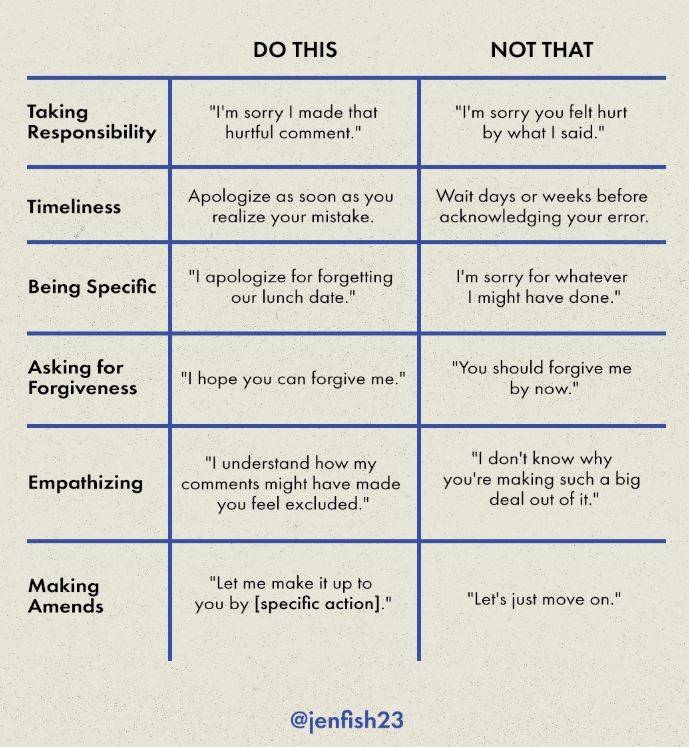
In her book Daring Greatly, researcher Dr. Brené Brown describes vulnerability as “the birthplace of connection.” Nowhere is that more visible than in an apology. When a man owns his mistake with sincerity, he shows strength — not weakness.
Here’s a five-step framework that demonstrates emotional intelligence for men and works in any relationship:
1. Acknowledge the Action
“I raised my voice, and that wasn’t right.”
This is where accountability begins. You name exactly what you did — no excuses, no deflection, no “if you felt that way” qualifiers.
Naming the behavior gives your partner something concrete to forgive. It transforms the moment from defensive to responsible.
Tip: Avoid vague apologies like “I’m sorry for whatever I did.” They signal avoidance rather than ownership.
2. Own the Impact
“I can see it made you feel disrespected.”
Intent doesn’t erase impact. You might not have meant harm, but harm can still be done.
Owning the emotional effect of your actions is what creates empathy. It tells your partner: “Your feelings matter more than my explanations.”
Dr. Harriet Lerner, a psychologist who has spent decades studying conflict and accountability, explains that empathy is what separates a real apology from a self-protective one.

“A true apology focuses on the injured party’s experience, not on defending the offender’s intentions.”
3. Express Genuine Remorse
“I regret that I hurt you.”
Remorse is the emotional bridge between understanding and the process of healing. Without it, apologies sound mechanical.
This is where tone, eye contact, and body language carry as much weight as words. Genuine remorse is about compassion, not guilt.
It shows your partner that you’re not just aware of what went wrong; you feel it too.
4. State What Changes
“Next time, I’ll pause before reacting.”
An apology without change is repetition waiting to happen.
This step demonstrates growth, which is the very essence of emotional intelligence for men. By describing the specific behavior you’ll adjust, you turn your apology into a plan.
It tells your partner that you’re not asking for forgiveness just to relieve guilt, but to rebuild trust through action.
Example:
Instead of “I’ll do better,” try “I’ll set a reminder for important dates so I don’t forget again.”
Specificity builds confidence in your commitment.
5. Invite Feedback
“Is there something I can do to make it right?”
This final step reopens the conversation and empowers your partner to express what they need for closure. It turns apology into collaboration.
Sometimes, the answer might be space, reassurance, or simply acknowledging that healing takes time. Whatever it is, being willing to listen without getting defensive shows emotional maturity and humility.
Putting It Together
When you follow this five-step structure, it goes beyond a mere apology to a demonstration of emotional leadership.
Every part of this process builds something:
- Accountability builds trust.
- Empathy builds safety.
- Remorse builds connection.
- Change builds confidence.
- Feedback builds partnership.
This is what a healthy apology in relationships looks like: a conscious, consistent effort to turn mistakes into moments of growth.
When ‘Sorry’ Isn’t Enough
Sometimes, even the most sincere apology can’t undo the damage. When trust is broken, whether through lies, neglect, or repeated emotional disconnect, words alone won’t be enough.
In these moments, the only apology that matters is changed behavior.
Psychologist and relationship expert Dr. John Gottman has studied thousands of couples and found that trust doesn’t return all at once. Instead, it’s rebuilt slowly “in hundreds of small moments done right.”
That’s because rebuilding trust isn’t a one-time event. It’s a process of consistency, honesty, and emotional reliability.
When Words Fall Short, Actions Speak
Apologies can open the door to healing, but actions are what keep it open. If you’ve hurt your partner more than once, your words might sound hollow even if you mean them.
This is where making amends begins. Instead of asking for instant forgiveness, you show it through consistent effort.
“Trust is earned in drops and lost in buckets.” — Kevin Plank
To rebuild trust, you need to replace promises with patterns.
Here’s how to rebuild trust after hurt:
1. Keep Your Promises
Nothing restores safety faster than dependability. Whether it’s showing up when you say you will, calling when you promise, or following through on small commitments, these everyday moments prove that your words carry weight again.
Consistency tells your partner: “You can rely on me.”
2. Be Transparent About Your Actions
Secrecy breeds doubt. Transparency rebuilds confidence.
If your partner’s trust was broken through dishonesty or avoidance, openness becomes your greatest ally.
Share your plans, communicate updates, and allow your partner to see that your behavior aligns with your words. This isn’t about surveillance, it’s about reassurance.
Openness turns anxiety into understanding.
3. Don’t Demand Forgiveness, Earn It
Forgiveness is a gift, not a right. When you pressure someone to “get over it,” you’re prioritizing your comfort over their healing.
Instead, focus on giving them what they need to feel safe again. That might mean patience, quiet reassurance, or consistent respect for their boundaries.
Psychologist Janis Abrahms Spring, author of How Can I Forgive You?, explains that genuine forgiveness follows earned trust, not requests for it:
“Forgiveness cannot be forced. It grows as you show accountability and empathy through time.”
When you demonstrate through behavior that you’ve learned from the pain you caused, forgiveness becomes possible naturally, not forcefully.
Why Consistency Matters More Than Perfection
In the forgiveness process, reliability and not perfection is the goal.
There will be moments when you fall short, moments when rebuilding feels slow. That’s normal. What matters is that your actions consistently show care, empathy, and commitment.

Each promise kept becomes a brick in the foundation of renewed trust.
Each act of openness strengthens emotional safety.
Each moment of patience restores belief that love can be safe again.
How to Apologize When She’s Still Angry
One of the hardest moments to apologize is when emotions are still raw. When she’s hurt, disappointed, or overwhelmed, your instinct might be to fix things immediately. You are probably trying to defend yourself, explain, or speed up the repair process.
But timing is everything, especially when you want to repair after a conflict.
A rushed apology often backfires because it feels like you’re trying to skip over the emotional part the part she needs you to acknowledge. Instead of feeling reassured, she may feel dismissed.
This is where vulnerability in men becomes essential. Instead of pushing for resolution, you create space for her feelings without taking them personally.
Try saying:
“I know you’re upset. I’m here to listen, and I’ll give you space if you need it. When you’re ready, I want to make things right.”
This simple acknowledgment does several powerful things:
- It validates her emotions.
- It signals emotional control.
- It shows maturity rather than defensiveness.
- It keeps the door open without pressure.
Emotional safety grows when a partner feels both heard and unhurried. Staying grounded and present while she processes her emotions allows you to communicate that the relationship matters more than your comfort.
In the long run, these moments strengthen trust. You don’t have to avoid conflict, but handle it with patience and compassion.
What a Real Apology Teaches Your Partner About You
A sincere apology is a reflection of who you are. When you apologize with honesty and accountability, you communicate powerful messages about your character, your values, and your willingness to grow.
A genuine apology teaches your partner three things:
1. You value the relationship over your pride.
You’re willing to be uncomfortable to protect the connection. That’s emotional maturity in men, the knowledge that love is strengthened by humility, not weakened by it.
2. You’re emotionally safe to be around.
When you can acknowledge hurt without getting defensive, your partner learns that conflict doesn’t have to lead to chaos. You become someone she can trust with her feelings, even the hard ones.
3. You’re growing not just reacting.
A mature apology shows that you’re committed to relationship growth, not emotional stagnation. You’re not stuck in old patterns but are learning and becoming a better partner through conscious effort.
In a world where emotional avoidance is common, accountability is magnetic.
It deepens respect, strengthens intimacy, and sets you apart.
This is the kind of emotional leadership that builds lasting, healthy love.
The Right Way Forward
Apologizing the right way makes you a stronger one. Because the man who can say, “I was wrong,” without shame, is the man who can also say, “I’m growing.”
Men who master the art of apology don’t lose authority. They actually gain emotional credibility. So the real strength isn’t in never being wrong but in having the courage to own it, repair it, and grow from it.


