















Many couples believe that the secret to a lasting bond lies in grand gestures like extravagant anniversaries, expensive vacations, or diamond jewelry. However, psychological research suggests that the true answer to how to build emotional connection is much smaller. It lives in the “micro-moments”, those tiny, everyday reaches for attention that experts call “bids.”
Understanding these bids is like learning a secret language. Once you learn to listen, you realize your partner is speaking to you all day long, even when they aren’t saying much at all.
What is a “Bid”? Understanding the Atomic Unit of Intimacy
A “bid” is any attempt from one partner to another for attention, affirmation, affection, or any other positive connection. It is the fundamental unit of emotional communication. When one person reaches out, they are essentially asking a silent, vulnerable question: “Do you see me? Am I important to you? Are you on my side?”
Bids are rarely dramatic. In fact, they are often disguised as mundane comments or non-verbal cues. Understanding this subtlety is the first step in learning how to build emotional connection. If you miss the bid, you miss the opportunity to strengthen the bond.
The Three Primary Responses In How to Build Emotional Connection
Once a bid is made, the receiver has three ways to respond. These choices are the building blocks of your emotional bank account. Let’s look at the profound psychological impact of each.
1. Turning Toward (The Gold Standard)
Turning toward is the act of acknowledging the bid with interest and validation. It doesn’t require a long conversation; it just requires presence. When you turn toward your partner, you are depositing in your relationship’s “savings account.”
- The Psychological Impact: It creates a “safety net.” When a partner feels heard in small moments, they feel safe enough to bring up big problems later. This is the most effective way to build emotional connection because it fosters trust.
- Examples: Your partner points at a bird outside. You stop what you’re doing, look, and say, “Oh wow, the colors on that one are amazing.” You have just validated their reality.
2. Turning Away (The Silent Relationship Killer)
Turning away is often more damaging than a loud argument. It occurs when the receiver is preoccupied, distracted, or simply misses the bid. You might stay focused on your phone, continue washing dishes without looking up, or give a one-word answer while staring at the TV.
- The Psychological Impact: This is the primary reason people ask, “Why do I feel disconnected from my partner?” Over time, the “bidder” feels invisible. Research shows that couples who eventually divorce “turned toward” only 33% of the time, while those who stayed together “turned toward” 87% of the time.
- The Danger Zone: When you turn away, the partner who made the bid feels a “sting” of rejection. Eventually, they stop bidding altogether to protect themselves from that pain.
3. Turning Against (The Red Light)
Turning against is an active, hostile rejection of the bid. It involves responding with sarcasm, irritability, or shut-downs.
- The Psychological Impact: This creates a toxic environment of defensiveness. If your partner says, “Did you see this news story?” and you snap, “I’m trying to work, can’t you see that?”, you haven’t just ignored them, you’ve also punished them for trying to connect. This is the fastest way to destroy an improving relationship communication.
The “Magic Ratio” and the Buffer of Goodwill
Stable relationships don’t have zero conflict; they just have a lot of “turning toward” to balance it out. Dr. John Gottman’s research discovered a “Magic Ratio” of 5:1. This means that for every one negative interaction (a fight or a “turn against”), there must be at least five positive interactions.
This ratio is a vital blueprint for how to build emotional connection. By consistently turning toward small bids, you build an Emotional Bank Account. When your account is full, you can survive a “withdrawal” (like a heated argument) without the relationship going bankrupt.
Bids for Connection Examples: Hidden in Plain Sight
To truly master how to build emotional connection, you must learn to recognize bids that don’t look like bids. Consider these common bids for connection examples:
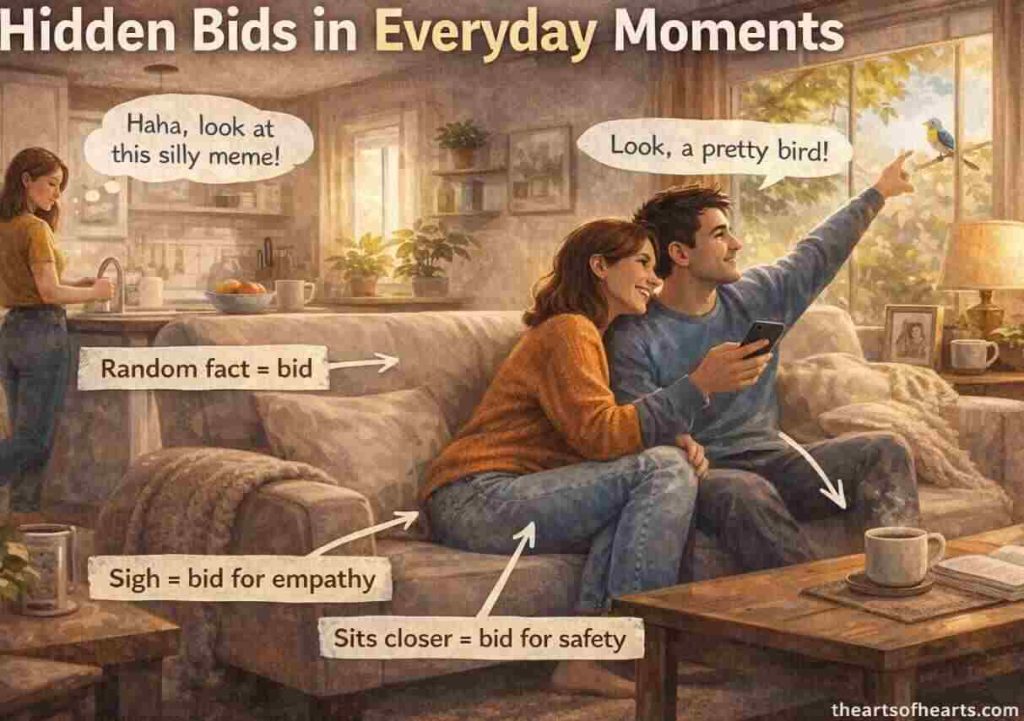
- The Sigh: Often interpreted as “being annoying,” a sigh is usually a bid for empathy. It’s an invitation to ask, “Hey, you sound stressed, everything okay?”
- The “Random” Fact: When your partner shares a trivia fact or a meme, they aren’t just sharing information; they are inviting you into their world.
- Physical Proximity: Simply sitting close to you on the couch or brushing against you in the kitchen is a bid for physical presence and safety.
A Step-by-Step Guide: How to Build Emotional Connection Daily
Now that you understand the theory, how do you put it into practice? Here is a roadmap for improving relationship communication and deepening your bond.
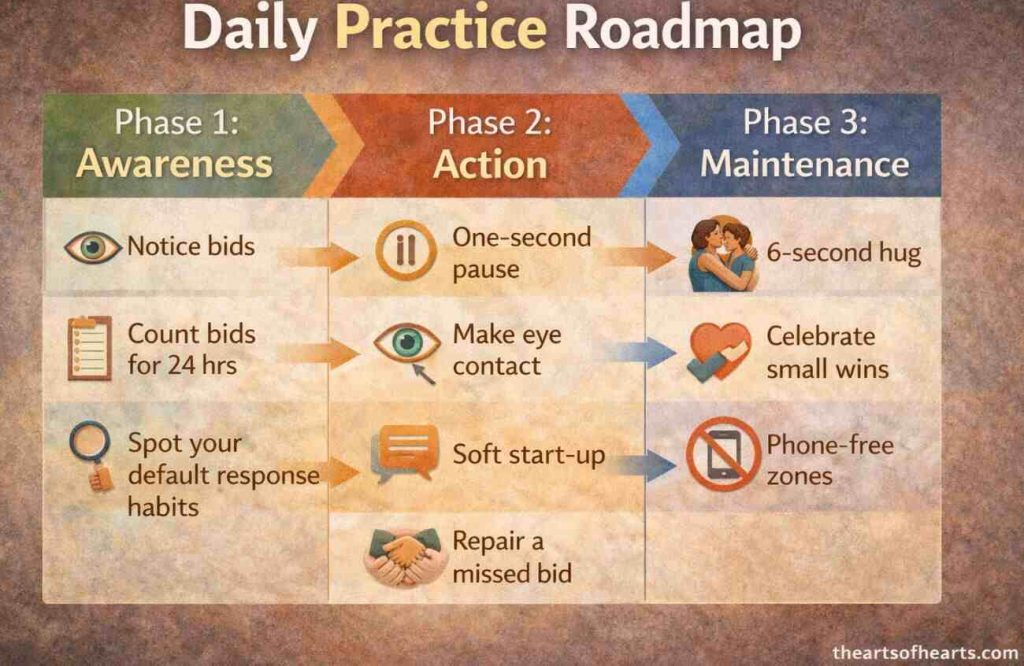
Phase 1: Awareness
- Sharpen Your “Bid Radar”: For the next 24 hours, try to count how many times your partner reaches out. Don’t worry about responding perfectly yet; just focus on noticing.
- Identify Your Habits: Do you tend to “turn away” when you’re stressed? Do you “turn against” when you’re tired? Awareness is the first step in how to build emotional connection.
Phase 2: Action
- The One-Second Rule: When your partner speaks, give yourself a one-second “buffer.” Stop your internal monologue and look at them. This tiny pause is the foundation of active listening.
- The “Soft Start-Up”: If you are the one making the bid, try to be clear. Instead of a vague sigh, try saying, “I’ve had a really hard day and just need to vent for five minutes.”
- Acknowledge the “Miss”: We are all human. If you realize you ignored a bid, go back to them. “I’m sorry, I was really focused on this email and didn’t hear you. What were you saying about the neighbor?” This “repair” is a powerful way to build emotional connection.
Phase 3: Maintenance
- The 6-Second Hug: Physical bids are high-yield investments. A hug that lasts six seconds releases oxytocin and builds a sense of security.
- Celebrate Small Wins: When you notice a positive shift in your communication, point it out. “I really appreciated that we spent those ten minutes talking this morning; it made me feel great.”
Overcoming Barriers to Connection
Sometimes, how to build emotional connection feels impossible because of outside stressors.
- Digital Distraction: The smartphone is the greatest “turn away” device ever invented. Set “phone-free zones” to ensure you don’t miss bids during dinner or before bed.
- Emotional Labor: Ensure that one partner isn’t doing all the “bidding.” If you notice your partner has stopped reaching out, it might be time for a gentle conversation about the health of your Emotional Bank Account.
Prioritizing these small, daily interactions allows you to do more than just “talking” and build a fortress of intimacy. This is the true secret of how to build an emotional connection that lasts a lifetime.