


















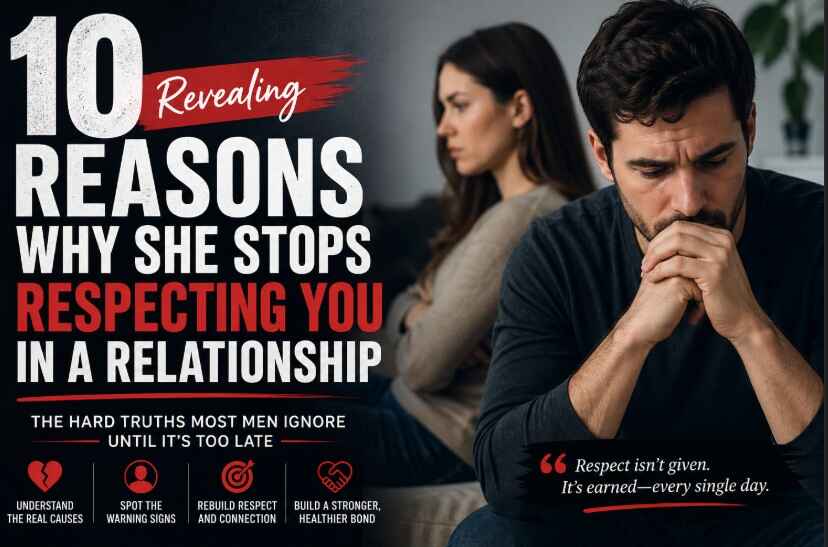
Respect is the silent foundation of every strong relationship. You can have love, attraction, and history, but once respect fades, everything else begins to collapse quietly. If you’ve ever wondered why she stops respecting you in a relationship, the truth is this: it’s rarely one big mistake. It’s a pattern of small behaviors repeated over time.
Research in relationship psychology shows that feeling respected is strongly tied to relationship satisfaction, commitment, and emotional connection. When respect disappears, even love struggles to survive. Let’s break down the real reasons this happens and what most people get wrong.
1. You Constantly Break Your Word (Where Why She Stops Respecting You in a Relationship Begins)
It rarely starts with something dramatic. More often, it’s the small things like the promises you didn’t think mattered that much. Saying you’ll call and not doing it. Committing to plans and canceling at the last minute. Agreeing to change something, then slipping back into old habits without acknowledgment.
Individually, these moments seem harmless. But together, they form a pattern. And patterns are what people trust, not intentions.
Over time, she begins to notice the gap between what you say and what you actually do. At first, she might give you the benefit of the doubt. Then she adjusts her expectations. Eventually, she stops relying on you altogether. That’s the quiet shift where respect starts to fade.
It’s not that she’s counting your mistakes, it’s that she no longer feels anchored by your words. And in any relationship, once your word loses weight, so does your presence.
Consistency, in this sense, isn’t about perfection. It’s about dependability. It tells her, without needing to say it, that you are someone she can trust to show up as you claim you will.
2. You Stop Leading Yourself (A Core Reason Why Women Lose Respect for Men)
This is often misunderstood. “Leading” doesn’t mean dominating or controlling the relationship. It’s far more personal than that. It’s about how you manage your own life, your direction, your discipline, your sense of purpose.
When those things begin to slip, it doesn’t go unnoticed. Maybe you’ve become more passive, less driven, or uncertain about where you’re headed. Maybe you’ve stopped challenging yourself or pushing forward in areas that once mattered to you.
What that creates is stagnation and uncertainty. And uncertainty makes it difficult for anyone to feel secure in a partnership.
Research supports this dynamic. Respect in relationships is closely tied to how we perceive a partner’s competence and agency, the sense that they are capable and in control of their own path. When that perception weakens, so does respect.
She may not articulate it this way, but she feels the shift. The energy changes. And gradually, the way she sees you begins to change with it.
3. You Tolerate Disrespect Instead of Addressing It
Respect isn’t just something you give, it’s also it’s something you maintain.
When dismissive comments slide by unchecked, when boundaries are crossed without consequence, when jokes come at your expense, and you laugh them off even when they bother you, you’re sending a message. Not through words, but through what you allow, and people pay attention to what’s tolerated.
This does not mean you react aggressively or turn every issue into a confrontation. But consistently ignoring behavior that undermines you creates an imbalance. Over time, that imbalance grows into something harder to correct.
Healthy relationships rely on mutual respect, and that respect is reinforced through clear, calmly enforced boundaries. Without them, frustration often builds on both sides.
Silence, in these moments, doesn’t come across as patience. It comes across as permission.
4. You Become Emotionally Dependent on Her
There’s a fine line between being emotionally open and becoming emotionally reliant—and it’s easier to cross than most people realize.
Sharing your thoughts, being vulnerable, and expressing how you feel are all essential parts of a strong relationship. But when your emotional stability starts to depend entirely on her when you look to her for constant reassurance, validation, or a sense of worth, the dynamic begins to shift.
Instead of standing beside you, she starts to feel like she has to carry you. That’s where the problem begins. No one wants to feel like they are responsible for another person’s emotional state all the time. It creates pressure. And pressure, over time, replaces attraction with obligation.
Independence doesn’t mean emotional distance or shutting her out. It means you’re grounded in yourself first. You bring stability into the relationship, not extract it from it.
And that distinction matters more than most people think.
5. You Avoid Difficult Conversations
At first, avoiding conflict can feel like the mature thing to do. You tell yourself it’s better not to argue, better to let things go, better to keep things calm. But unresolved issues don’t actually disappear instead they settle. Eventually, they resurface often with more weight than they had to begin with.
When difficult conversations are consistently avoided, resentment quietly takes their place. And resentment is far more damaging than conflict.
Studies in relationship psychology show that respect and satisfaction are closely tied to open communication, especially during disagreements. Being able to address issues directly, without avoidance or escalation, builds trust and emotional safety.
When that’s missing, it sends a different message that you’re unwilling or unable to face discomfort when it matters. And over time, that doesn’t come across as peacekeeping. It comes across as a weakness.
6. You Stop Putting Effort Into Yourself
At the beginning of a relationship, effort comes naturally. You take care of how you look. You think about how you show up. You are engaged, present, and intentional. Over time, that effort can quietly fade, not because you no longer care, but because you have grown comfortable.
Comfort, when left unchecked, often turns into complacency.
It shows up in subtle ways. You stop pushing yourself physically. You lose curiosity. You settle into routines that require very little of you. From your perspective, nothing feels dramatically different. From hers, something important has shifted.
Respect is closely tied to admiration. People are drawn to those who are growing, evolving, and taking themselves seriously. When that stops, admiration tends to fade with it.
Research in relationship psychology highlights that perceived partner value, which includes effort and self-development, plays a role in maintaining attraction and respect over time. When growth stalls, so does the way a partner is perceived.
This is not about constant self-improvement for the sake of pressure. It is about staying engaged with your own life. When you invest in yourself, it naturally reflects in how you show up in the relationship.
7. You Seek Validation Instead of Standing Firm
There is nothing wrong with wanting to feel appreciated. The problem starts when you rely on it to feel secure.
If you find yourself constantly asking what she thinks before making decisions, or needing reassurance for things you should already feel confident about, it changes how you come across. Not in a dramatic way, but in a gradual shift that becomes noticeable over time.
It can sound like over-explaining your choices, softening your opinions to avoid disagreement, or looking to her for approval before you act. On the surface, it may seem like consideration. Underneath, it often signals uncertainty.
And uncertainty has a way of affecting respect.
Confidence is not about being loud or dominant. It is about being settled in your decisions and comfortable with your direction, even when someone else may not fully agree. When that steadiness is missing, the dynamic changes. She begins to feel less like she is with someone grounded and more like she is with someone seeking direction.
Over time, that shift matters.
8. You Prioritize Her Over Your Purpose
Putting her first sounds like the right thing to do. To make the relationship your main focus. In reality, when taken too far, it often has the opposite effect.
When you start setting aside your goals, your interests, and the parts of your life that once gave you identity, you lose something essential. Not just for yourself, but for the relationship as well.
The person she was initially drawn to likely had direction, interests, and a sense of purpose. When those things begin to disappear, it changes how she experiences you.
Healthy relationships are not built on one person becoming everything for the other. They are built on two individuals who each have their own sense of direction and bring that into the relationship.
Studies on long-term attraction suggest that maintaining individuality and personal goals supports both respect and desire. When one person loses that individuality, the relationship can start to feel unbalanced.
Being committed does not mean losing yourself. It means staying grounded in who you are while choosing to build something with someone else.
9. You Become Predictable and Stop Creating Emotional Engagement
There is a certain comfort in routine. Knowing what to expect can make a relationship feel stable. But when everything becomes predictable, interest tends to fade quietly in the background.
If conversations start to feel repetitive, if time together feels more like a habit than a connection, or if there is little variation in how you engage with each other, the relationship can begin to feel flat. Not necessarily bad, just lacking energy.
That lack of emotional engagement often affects both attraction and respect.
Research on relationship satisfaction shows that shared novel experiences and emotional engagement play a role in maintaining connection and excitement. Without them, relationships can feel stagnant, even when there is no obvious conflict.
This does not mean you need constant excitement or dramatic gestures. It can be as simple as bringing curiosity back into the relationship. Trying new things, having deeper conversations, or breaking out of routines that no longer serve you.
Respect grows when the relationship feels alive, not just maintained
10. You Fail to Set and Enforce Boundaries
Boundaries are often misunderstood. They are not tools for control or creating distance, but rather creating clarity.
When boundaries are unclear, people tend to test limits, sometimes without even realizing it. It might start small. A comment that crosses a line. A behavior that feels off but goes unaddressed. Over time, those moments accumulate.
If nothing is said or done, the message becomes clear. This is acceptable.
That is where the imbalance begins.
Healthy relationships rely on mutual respect, and that respect is reinforced through boundaries that are both communicated and upheld. Without them, one person often ends up overextending while the other takes more space than they should.
Enforcing boundaries does not require aggression or confrontation. In fact, it is more effective when done calmly and consistently. It is less about reacting in the moment and more about setting a standard over time.
When you are clear about what you accept and what you do not, it shapes how others treat you.
Signs She Doesn’t Respect You Anymore
Before trying to fix anything, it helps to recognize what is actually happening.
A loss of respect rarely shows up as a single, obvious moment. It tends to appear through patterns in behavior.
You might notice that she dismisses your opinions more quickly than before, or interrupts you without much awareness. Conversations that once felt balanced may now feel one-sided. The effort you put in may go unacknowledged or even expected without appreciation.
In some cases, the shift becomes more visible. She may challenge you in ways that feel less like healthy disagreement and more like disregard, especially in front of others. Your time, boundaries, or preferences may carry less weight than they used to.
Individually, these moments might seem minor. Together, they point to something deeper. They reflect a change in how you are being perceived and treated.
How to Regain Respect in a Relationship
When respect has been lost, trying to talk your way back into it rarely works. Respect is built through patterns, so it has to be rebuilt the same way.
The starting point is not the relationship. It is you.
Rebuilding self-respect comes first. That means being honest about where you have been inconsistent, where you have avoided responsibility, and where you may have compromised your own standards.
From there, consistency becomes essential. Doing what you say you will do, even in small things, begins to restore reliability over time.
Boundaries also need to be re-established. Not reactively or emotionally, but with clarity and follow-through. When your actions align with your standards, people adjust.
Growth plays a role as well. When you become more engaged in your own life, whether physically, mentally, or professionally, it shifts how you show up and how you are perceived.
And then there is communication. Not over-explaining, not seeking constant reassurance, but speaking clearly and standing by your decisions.
If you want a clearer picture of what a balanced, respectful relationship should feel like, this guide breaks it down in a practical way.


